|
Alumni Advisory Council Offers Advice
The College of Science and Technology Alumni Advisory Council
met with the dean, program coordinators, chairs, director,
and members of the Center for the Sciences building
committee on Friday, September 30.
Alumni attending included:
- Mr. Rob Mancini, Chief Technology Officer for Washington, D.C.
- Dr. Earnie Paylor, President of WorldTech International
- Dr. Racquel Collins-Underwood, cancer researcher, St. Judes Children's Research Hospital
- Mr. Mark Hanna, Research and Development Manager, Johnson & Johnson
- Mr. Chris Flor, Director of Consulting,Southwest Virginia Center of Excellence, CGI Federal
- Mr. Seth Peery, Senior GIS Architect, Enterprise GIS Research and Development Administration department at Virginia Tech
The group discussed the latest college accomplishments,
changes and the planning for the new building. Distinguished
alumni from many college programs offered insight into the
needs of companies with employees in science, technology
and math. In addition to proficiency in the STEM
disciplines, they also emphasized the need for students
to be able write effectively.
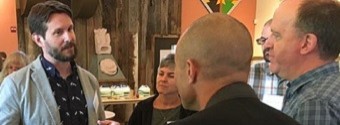
After the meeting, the alumni spoke with interested
students about their experiences upon graduation and job
search tips.
The CSAT Alumni Advisory Council will meet again in October 2012.
IT Students Presents Cyber-Security Research at Prestigious Conference
Information technology student Austin DeVinney's interest
and curiosity has paid off with a summer internship opportunity
with cyber-security expert and Associate Professor of
Computer Science at the University of Virginia David Evans.
Evans was invited to Radford University by the CSAT STEM
Club in the spring as a speaker for the Distinguished
Lecture Series. Information technology faculty member
Prem Uppuluri says that's when DeVinney took advantage
of opportunity.
"Immediately after the lecture, Austin got a chance to
meet informally with Dr. Evans," says Uppuluri. "This
meeting impressed Dr. Evans enough that it turned into
a summer research opportunity for him at UVa," says Uppuluri.
During the summer, DeVinney collaborated with Evans and
his computer security student group. "I came into the
group and was put on a project called 'GuardRails.' It
is a source-to-source Ruby on Rails security framework
that will take annotated code and transform it into a
more secure version," says DeVinney.
In addition to the project, DeVinney collaborated with
Evans on an academic poster that detailed features and
integrations of the 'GuardRails' system, which he
presented in August at the USENIX Secruity Symposium
2011 in San Francisco.
According to Uppuluri, this was an incredible opportunity
for DeVinney to meet some of the leading scientists in
computing. He says this symposium is considered by
many security experts as the best conference in the world.
Many national media publications such as InformationWeek,
Computer World and Forbes, attend the conference to learn
about the leading edge of computing research.
DeVinney said that he continues to work with Evans
throughout the school year. "We are currently developing
an add-on for Google+ that I cannot give details on
just yet," he adds.
Students Present Research at American Chemical Society Meeting
In October, five undergraduate researchers in chemistry
presented their work at the South East Regional Meeting
of the American Chemical Society (SERMACS) in Richmond.
Students across the college receive undergraduate research
experience and, with the encouragement and guidance of
their faculty mentors, travel to regional and international
conferences to present their work.
Students Brittany Wike and Alex Noble presented their
research with chemistry faculty member Kimberly Lane
entitled "Mutagenesis of the active site and subunit
interfaces in bacterial β- glucuronidase."
"We are looking at the active site and subunit interfaces
of the enzyme to learn more about the thermodynamics of
it," says Wike about her research.
Wike took biochemistry with Lane and knew that she wanted
to be involved in Lane's research. "I expressed my
interest in her research and joining her team. That
semester she took me in as one of her researching
students," says Wike.
Wike says that SERMACS was her first conference and she
loved it. "The experience as a whole was just incredible.
The posters and the presentations were interesting, and
the way the conference was laid out was well done," she
says. She enjoyed that there was always something to
learn and do at the conference. "I particularly enjoyed
walking around the different vendors and seeing what new
gadgets they brought with them. I also like the graduate
schools that came and passed out information about their
programs," she said.
She said that as a biology major and chemistry minor,
the conference allowed her to learn more about research
across the region. "I was able to also appreciate more
of the things some of the other presenters were talking
about because the professors at RU do such a nice job
explaining material and helping students. I think that
was the best part about this experience in regards to my
education experience at Radford," she explains.
The presentations and speaking with the vendors at the
conference gave Wike an idea of what awaits her upon
graduation. "SERMACS gave me a little bit of a window
into what it would be like at some of the schools that
came to give out graduate school information, or maybe
one day I will work with one of the vendors to buy a
piece of equipment," says Wike.
Chemistry student Rebecca Mayfield presented a poster
regarding her work with faculty mentor Joe Wirgau
entitled "Thermodynamic investigation of ternary complex
formation of ferrioxamine B and imdazole." Wirgau gave
a talk about this research in addition to his previous
research results entitled "Role of ternary complex
formation with iron(II) chelators in the reduction of
ferrioxamine B by biological reducing agents." He says
that his research is attempting to better understand
redox chemistry of the iron overload drug Desferal.
Mayfield said that she enjoyed learning more about
graduate programs available for chemistry students.
"There was a graduate fair at the conference, which was
a good time to get to talk with reps from various
graduate programs and to get a feel for some different
career opportunities after graduation. It was also good
just to talk with professionals and people already in
the work-force," she says.
Chemistry student Jacob Shelton presented his research
with faculty mentor Christine Hermann entitled
"Synthesis of Ethanol from Sugar, Starch, and Cellulosic
Feedstocks."
Chemistry faculty member Tim Fuhrer and his student
Chris Pregot presented their research "Computational
evidence for the effect of chlorine as a catalyst for
fullerene formation." In addition, Fuhrer gave a talk
entitled "Y2C2@C92 and Y2C2@C82: Two distinct carousel
type cluster rotations."
Professors and Alumnus Collaborate to Promote Land Productivity
Biology associate professor Christine Small will be
collaborating with management associate professors Iain
Clelland and Gary Fetter, and CSAT Alumni Advisory
Council member and geography alumnus David Bradshaw on
a project to increase land productivity in southwestern
Virginia. The study "Terra2B: Development and Scenario
Testing of a GIS-based Model of Appalachian Agroecosystems
Management" is funded by a $17,700 Radford University
Faculty Research Grant.
The project will develop and test a science and
technology-based model of Appalachian agroecosystem
management on privately-owned lands in southwestern
Virginia. "Our goal is to enhance economic growth for
land owners and local communities by increasing and
generating new avenues for natural resource productivity
while also maintaining ecosystem integrity," says Small.
According to Small, about half of the population of the
New River Valley (NRV) region live on land classified as
rural. Yet more than 700,000 acres of land in the NRV is
owned by private citizens who live outside of the state.
She says, these tracts are unmanaged and the potential
financial productivity is lost.
Non-residents currently have few options to manage their
land effectively. Labor is difficult to acquire.
Information is difficult to utilize because of its
complexity. The support network for private landowners
is fractured and severely limited. Another complication
is that state and federal employment for advisors, such
as agricultural extension officers, is being reduced,
leaving a rural workforce that lacks expertise.
As a result, it is quite common for land, the most basic
business asset, to be a drain rather than a source of income.
Small adds, private land management practices can have
significant impacts on local ecosystems. For example,
agricultural land remains the largest contributor of soil
erosion and fertilizers and insecticides making their
way into streams and other aquatic systems. Erosion from
poorly designed forest roads is also a major problem for
freshwater fish populations, rare mussels, and other
invertebrates in wetland systems, says Small. Large areas
of the rural southwest Virginia landscape are
underutilized for various reasons, including labor migration
from rural to suburban or urban areas, low soil productivity
and landscape constraints such as steep topography, low
agricultural commodity margins, and fragmented land ownership
patterns.
The Terra2B project is currently in its initial phase.
The team will work throughout the 2011-2012 academic year
and through the summer on database establishment and model
testing. Initial work will focus on expanding a GIS
database for a 200 acre farm in Giles County in collaboration
with Bradshaw, president of InteractiveGIS in Blacksburg,
and Robert Giles, Professor Emeritus of Virginia Tech's
College of Natural Resources .
The team will expand this initial database by adding
clusters of absentee land owner tracts and ecosystem,
best management practices, and cost and revenue data.
The funded proposal includes a fall 2011 and spring 2012
undergraduate biology student to aid in collection of field
and digital data, the development of a GIS database, and
more extensive literature review on indicators of ecosystem
health and sustainable land use practices. Kiersten Newtoff,
an undergraduate biology major with an environmental
concentration and geospatial minor will be working with
Small on this project throughout the year. The grant also
includes a stipend for a graduate assistantship in the
College of Business and Economics.
"This project will bring together our best current knowledge
for predicting effects of natural and human-induced
environmental change resulting from managerial decisions
on agroecosystems. We are making use of modern technological
advances in remote sensing, GIS, and Multi-Criteria Decision
Making (MCDM) to precisely test for optimized agroecosystem
outcomes on clusters of private land tracts," adds Small
The research team hopes to create a system that helps
absentee and local landowners make the most of their
resources in an environmentally responsible way.
SCHEV Approves Geospatial Science Program
The State Council of Higher Education for Virginia (SCHEV)
on Tuesday approved a Radford University degree program
that will prepare students for careers in geospatial sciences.
The College of Science and Technology's new geospatial
science program, approved by RU's Board of Visitors in
November, is set to begin in the fall and to graduate its
first class in 2015.
The geospatial science degree program, the first of its
kind in Virginia, will provide specialized coursework
for students who seek training in geographic information
systems (GIS), digital cartography techniques and
applications, remote sensing, environmental issues and
geography in preparation for careers in geoinformatics
or environmental planning and management.
"The degree in geospatial sciences will provide Radford
University students enhanced opportunities to join a
rapidly evolving workforce and to serve the Commonwealth
by applying advanced technology and spatial analysis
techniques to conduct research and solve problems," said
Orion Rogers, dean of the College of Science and Technology.
"This emerging field is transforming the way that
geographic data is analyzed for scientific research and
applications as well as the way business is conducted globally."
The program is designed to prepare students for careers
as GIS analysts, planners, surveyors, cartographers,
environmental quality engineers, water quality engineers
and telephone systems mapmakers.
Students enrolled in the geospatial science program will
gain knowledge in the classroom, laboratory and in the
field, working alongside faculty expert mentors while
using the latest geospatial science technology.
"Our students will benefit from the faculty expertise
that already exists in geographic information systems,
digital cartographic techniques, digital imaging processing
and GIS field research methods," Rogers said.
The State Council of Higher Education for Virginia (SCHEV)
administers a variety of educational programs and makes
higher education public policy recommendations to the
governor and General Assembly in such areas as capital
and operating budget planning, enrollment projections,
institutional technology needs and student financial aid.
Physics and Anthropological Sciences Professors Research Better Way to Identify Covert Burials of Human Remains
Analyzing historic burials may give clues to the best way
to find covert burials at crime scenes. Anthropological
sciences professor Cliff Boyd and physics professor Rhett
Herman think that examining and documenting Ground Penetrating
Radar (GPR) signals from marked and unmarked graves at
historic cemeteries will help law enforcement effectively
use GPR to recognize unmarked burials at crime scenes.
“With similar soil conditions and similar antennae on the
GPR, graves from historic cemeteries and graves from crime
scenes should be comparable,” says Boyd. He says, at a
crime scene “we will be able to then say, yes, there is a
burial here, based on what we know graves look like from
known cemeteries.”
Boyd and Herman are able to conduct their research project
“Using Remote-Sensing of Known Grave Sites to Develop a
Forensic Science Model for Identifying Covert Burials”
thanks to a $15,542 Radford University faculty research award.
Their project seeks to collect data to statistically evaluate
and validate non-invasive, or non-intrusive, search techniques
which are commonly used by law enforcement and forensic
personnel in conducting searches for covert burials. This
research focuses specifically on the use of GPR.
The project goals are to compare the efficiency of three
different types of antennae used with the GPR—the 100MHz,
250MHz, and 500MHz—in terms of their identification of known
grave sites in western Virginia. By evaluating the success
in identifying known sites in various settings, more
accurate estimates of their success in locating covert or
hidden graves (especially cold cases) in similar environments
can be developed. This information will greatly benefit
law enforcement agencies in western Virginia by identifying
best practices for searching for covert burials (excavated
to hide human remains or other incriminating materials)
using the GPR. This will reduce the time and funds needed
for law enforcement to successfully complete a search.
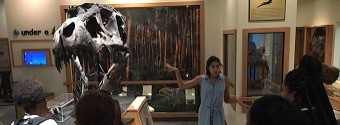
RU Museum of the Earth Sciences Now Affiliate of VMNH
The Radford University Museum of the Earth Sciences (MES)
has become an affiliate of the Virginia Museum of Natural History (VMNH).
According to VMNH this three-year-long designation implies
mutual recognition and support of their common educational
purpose. RU's MES was chosen as an affiliate because of
its emphasis of Virginia's natural history and is recognized
as a science-based facility devoted to research and the
education of patrons of all ages in one or more
disciplines of the natural sciences.
This partnership offers the RU MES enhanced opportunities
to host VMNH traveling exhibits, to offer lectures by
VMNH curators, to publish articles in the VMNH newsletter,
to link to VMNH's website as an affiliate, and to
receive collections advice and assistance from VMNH's
collections department.
The Museum of the Earth Sciences, a component of the geology
program in the School of Environmental and Physical
Sciences, College of Science and Technology serves as
an educational resource for earth science related themes
for the university, K-12 students, and the general public.
Encompassing the earth science related fields of geology,
oceanography and physical anthropology, the Museum of the
Earth Sciences fosters an appreciation of the Earth, its
past, present, and future, and its interaction with humans.
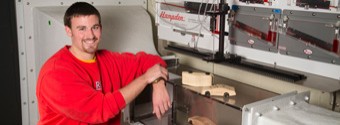
Math Major Interns at Aspen Motion Technologies in Quality Control and Optimization
Senior mathematics major and Charlottesville native Paul
Sauer wanted to put his classroom knowledge to the test
in an internship with local manufacturing company Aspen
Motion Technologies. With a dual concentration in applied
math and statistics, Sauer says this experience allows
him to get a feel of what might be expected of him in the
“real-world.”
“I think this is a going to be a great experience for me
because I am actually applying the knowledge I have
learned throughout college to real life problems in
industry. My courses in applied mathematics have definitely
helped me develop a new way of thinking by allowing me
to view a problem from multiple angles and figure out the
best way to solve it. My statistics courses however, have
absolutely been the most helpful towards my internship
as the internship is dealing with statistical experiments,”
says Sauer.
His internship will conclude at the end of this semester
and he is hoping that it will prepare him for a future
as a statistician in industry or manufacturing.
Sauer says he is working mainly with quality control and
optimization during his internship. Aspen Motions makes
small brushless DC motors which go in a variety of products
including the water pumps that cool the IBM super
computers, Jacobson lawnmowers, industrial fans and data
storage devices.
“I currently am working on a design of an experiment
dealing with the potting of silicone in the motor for the
Jacobson lawnmower,” says Sauer. “When the lawnmower
reaches an operating temperature of 150 degrees Celsius,
the silicone begins to bubble and seep into the internal
diameter of the motor resulting in poor performance. My
experiment deals with how the silicone is originally potted.
I am trying various combinations of factors that are
involved in the process to try and find the combination
that produces no bubbling in the silicone,” says Sauer.
Mathematics and statistics department chair Jill Stewart
helped Sauer find this internship experience. “I have been
working with Dan Snuffer, the Quality Engineer at Aspen,
for several years now placing interns. Dan serves as the
site supervisor and I serve as the faculty supervisor for
interns at Aspen. I procured the internship for Paul last
spring when I learned that Paul needed the course,” adds
Stewart.
Stewart says an internship is an invaluable experience.
“There is a chasm of difference between the college
experience and the experience of a real job. Internships
bridge that gap. Students learn about the origination
of problems, the process of teamwork, ways to research
solutions, etc. when they spend time on a factory floor
or in a business office. Through the internship experience
a student gets a jump on collegiality, a positive attitude,
good work ethic, and professional behavior,” says Stewart.
“To students debating on whether or not to do an internship
before graduation, I would say go for it. It has been
one of the best learning experiences for me and has really
given me a glimpse of what I will possibly be doing in
the future. It is a lot of work, but the payoff is
humongous,” adds Sauer.
|