Radford students get Wicked with solving the world’s most difficult issues
by Chad Osborne
November 18, 2026
If you walked into the atrium of the Artis Center for Adaptive Innovation and Creativity on Thursday evening, Nov. 5, you were greeted by a spirited, exuberant energy.
You might even say a Wicked energy.
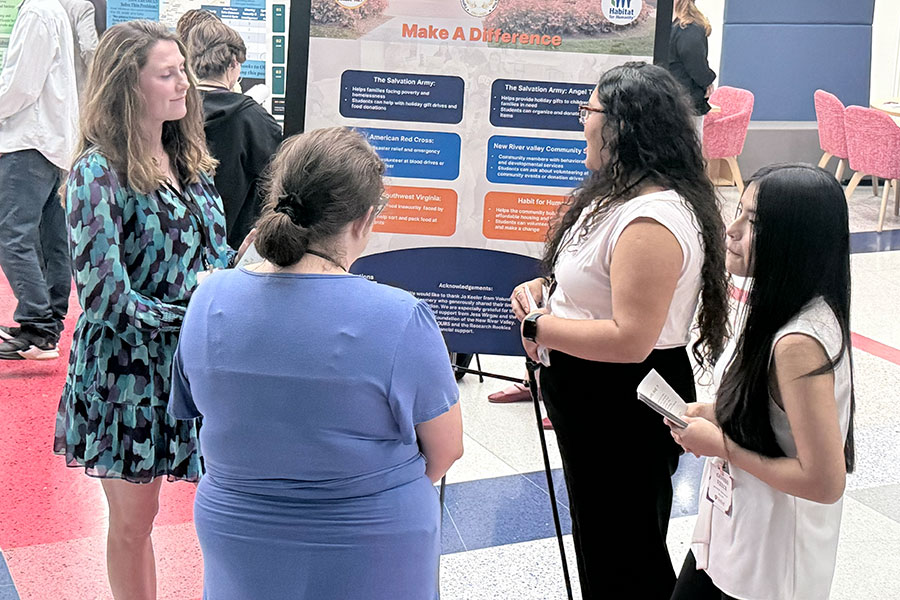
Twice a year, Radford University hosts the Wicked Festival, where scores of students gather to display and speak to visitors about their semester-long research into some of the world’s most difficult and seemingly impossible-to-solve problems.
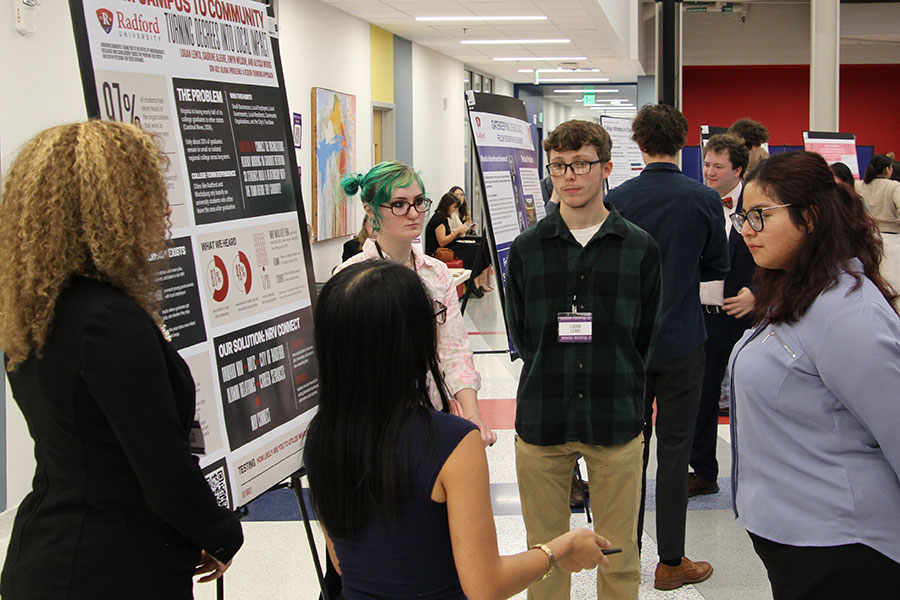
The festival, as described by its founders and organizers, is “an exposition of student problem solving.” The Wicked Festival is a project of the Highlander Center for Character and Public Impact, convened by the College of Humanities and Behavioral Sciences. It is supported by the Center for Innovative Teaching and Learning (CITL) and the Office of Undergraduate Research and Scholarship (OURS). The College of Visual and Performing Arts hosts the festival in the Artis Center.
“There is such a good energy here, and I love being here to support the students,” said Jessica Mattox, Wicked Festival coordinator and English instructor in the School of Writing, Language, and Literature. “I always learn so much from students across the university about so much research that is happening on campus.”
This year’s Wicked Festival featured research from about 335 students enrolled in courses provided by five of the university’s colleges.
The process of participating in the Wicked Festival kicks off with the beginning of each semester. Students enrolled in designated Wicked Initiative courses pick a topic and work in groups for several weeks to conduct research, which could be anything from finding sources in publications to talking with community leaders. From there, students write papers, give in-class presentations and design posters to concisely convey their work at the festival.
Talking about their research and answering questions can be challenging, said Hazel Glenn, a sophomore graphic design major from Winchester, Virginia. Glenn and her project partners, Keira Woods and Stephanie Dressler, researched the effects of social media on young adults.
The research “made us step out of our focus areas,” explained Dressler, a sophomore chemistry major from Narrows, Virginia. “It was super interesting to be able to do this and talk to people about it. It gets us out of our comfort zone.”
But it didn’t happen immediately. It took a few turns for the trio to find their groove. “We’re definitely getting more comfortable,” Glenn said about 15 minutes into their hourlong session. “In the beginning, we weren’t exactly sure how it would go, but so far it’s been great.”
Afterward, sophomore Azzy Straus was thrilled to have one prominent visitor step up to her presentation. “President Bret looked at my poster,” the art education major from New Market, Virginia, said, referring to Radford University President Bret Danilowicz.
Radford’s Wicked Festival began in the fall of 2021 as a collaboration between the university’s Department of Political Science and Department of Philosophy and Religious Studies. It is a product of Radford’s Wicked Problems Initiative, which is based on decades of research aimed at engaging students in research that develops their problem-solving skills as they examine some of the world’s most complex problems. This fall semester’s festival was the 11th for Radford.
“Students have an amazing time learning through Wicked,” Mattox explained. “They are able to tap into problems in our community and across the region and across the world. And what’s really important is that they are able to find ways to make a difference.”
Topics for the fall 2026 Wicked Festival examined a variety of issues. One group of students explored the possibility of making Radford a smoke-free campus. Another questioned the impact of finances on the mental health and well-being of university students. More broadly, one group investigated how the Trump administration should engage the Taliban to advance U.S. interests.
Throughout the festival, four groups of three judges visited the student presentations, asking tough questions and making notes to fill out a rubric that ultimately would decide which teams were most deserving of awards. Each team of judges was made up of a Radford faculty member, a Radford alumnus and a previous Wicked Festival award winner.
“The judges deliver a really rich result because they come from such different backgrounds and experiences,” Mattox explained.
As the 12 judges deliberated following two hours of presentations, student participants had an opportunity to hear an inspirational talk from Stacey Brayboy, a member of the Radford University Board of Visitors and senior vice president of public policy and government affairs at March of Dimes.
The evening concluded with the announcement of this year’s Wickie Awards in four categories: Outstanding Presentation, Distinguished Research, Impactful Solution and Rising Star.
Below is a list of the winners and their projects. Their supervising faculty members and courses are listed in parentheses.
Impactful Solution
Gold: "Greenwashing the Pink Tax: Harmful Ingredients in Cosmetics and How the Industry Markets Them" by Rylee Lyons (COMS 304: Multimedia Journalism, Hyeri Jung, Ph.D.)
Silver: “From Recruitment to Retention: Communication Strategies for Retaining Gen Z Volunteers at the American Red Cross” by Laken Rickey (COMS 610: Organizational Communication, Zehui Dai, Ph.D.)
Bronze: “Effects of Nitrate Pollution on the Great Barrier Reef” by MJ Luckett, Haley Taylor, Allison Schilpp and Addison Myers (GEOG 140 Honors: Intro to Environmental Science, Naveen Joseph, Ph.D.)
Distinguished Research
Gold: “Radford University Should Be a Smoke-Free Campus” by Charlie Schoenig (Pro) and Logan Surber (Con) (COMS 332: Argumentation and Advocacy, Zehui Dai, Ph.D.)
Silver: “Who Powers Radford? Rethinking Utility Monopolies Through a Local Lens” by Therese Root and McKenzie Morman (POSC 330: State and Local Government, Chapman Rackaway, Ph.D.)
Bronze: “The Impact of Finances on Student Mental Health and Well-being” by Emma Hogsten, Trinity Reed-Winston, Coni Sandoval, Ethan Tickle and Sarah Zurfluh (DSN 402: Global Design Studio, Kevin Peterson, M.F.A.)
Outstanding Presentation
Gold: "America First in Afghanistan: How Should the Trump Administration Engage the Taliban to Advance U.S. Interests?” by Sydney Howell-Wampler and Tyler Russell (POSC 350: U.S. Foreign Policy, Paige Tan, Ph.D.)
Silver: "The Human Rights Tragedy in Burma" by Jakob Genest and Mikey Lester (POSC 350: U.S. Foreign Policy, Paige Tan, Ph.D.)
Bronze: “From Campus to Community: Turning Degrees into Local Impact” by Sabrine Alegre, Logan Lewis, Gwyn Wilson and Alyssa Woods (DSN 402: Global Design Studio, Kevin Peterson, M.F.A.)
Rising Star
Gold: “Catering to the Community: Connecting the New River Valley Student Population to Food Access Volunteerism” Students: Layla Criner, Isabella Deel, Lauren Hatfield and Noemi Clymer Kurtz
Mentors: Joe Wirgau, Therese Root (OURS 100: Introduction to Research and Creative Inquiry, Joe Wirgau, Ph.D.)
Silver: "Flock Off: Flock Cameras in Pulaski" by Madison Steiner, Abby McCoy, Desiree Williams, and Sophie Willis (POSC 130: Changing the World, Paige Tan, Ph.D.)
Bronze: “The Impact of Oil Spills on the Chesapeake Bay” by Sophia Bogan, Emily Lickert and Evan Martin (ENGL 306: Professional Writing, Jessica Mattox, M.A.)