Criminal justice professor’s work plants seeds with institutionalized youth
by Chad Osborne
August 06, 2026
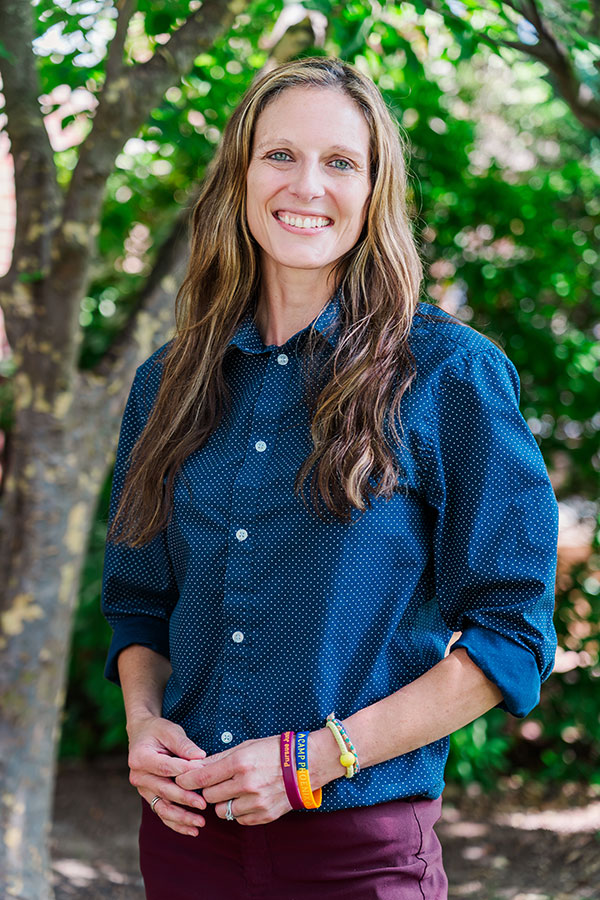
In a moment of joy, a teenage boy picked up a small tomato plant and tossed it high into the air toward the towering, intimidating wall, only to see it stick to the razor wire several feet away.
“What are you doing?” those around him inside the juvenile detention center asked. “You’re not supposed to do that here.”
But at the same time, “We all just started laughing,” recalled Lindsay Semprevivo. “Because in that moment, it was just a kid being a kid.”
When Semprevivo first joined the Radford University Department of Criminal Justice faculty in 2022, one of the first things she wanted to do outside of the classroom was start a gardening program with juveniles in detention. As the program grew, she began including her Radford students in the process as a way of connecting scholarship with practice.
A firm believer in the therapeutic benefits of gardening, Semprevivo began volunteering at the New River Valley Juvenile Detention Home in nearby Christiansburg, Virginia. After two years, she started a six-week restorative horticulture program for institutionalized youth at the home.
“I felt lucky that my goals aligned well with those already established by the home’s superintendent,” Semprevivo said of Joe Young '98, who earned an undergraduate degree in criminal justice from Radford. “Not every person in these institutional leadership roles prioritizes therapeutic care, and we are grateful for those who value that and want to grow that collaboration.”
The summer enrichment course explored growing vegetables as trauma-informed care, a supportive approach that asks “What happened to you?” instead of “What is wrong with you?”
“It helps kids step away from thinking, ‘I’m just an offender who is locked up,’” the Radford University associate professor of criminal justice explained. “It helps us – the volunteers, researchers and staff at the detention home – show youth the impact of previous trauma and explore pathways toward healing, growth and restoration, not just within themselves, but within their communities.”
The ability to harness growth and joy – like tossing a tomato plant – even when confined is at the core of Semprevivo’s work.
Through community-engaged research focused on violence prevention, restorative interventions, prison education and reentry, Semprevivo, through her hands-on work and research, seeks to identify pathways that promote healing, resilience and long-term well-being among individuals impacted by the criminal legal system.
Those ideas led to the six-week horticulture program, which is scheduled like this:
Week 1: Roots and Grounding
Week 2: Nurturing Growth
Week 3: Weeding Out Harm, and You Are More Than Your Offense
Week 4: Building Support Systems
Week 5: Blossoming and Beauty
Week 6: Planting Seeds of the Future
In the early stages of the program, the juveniles planted seeds – hot peppers, watermelons, blueberries, cucumbers, tomatoes, strawberries and more – and Semprevivo spoke to the mostly male juveniles about the importance of sunlight, soil and water in plant growing as metaphors for what they needed to help them build healthier environments and grow stronger.
Midway through the program, Semprevivo asked the juveniles – their average age is about 15 – to write their offense on a piece of paper. “It’s for your eyes only,” she said, explaining no one else would see. Then, the juveniles were told to destroy the papers. “I wanted them to feel empowered,” Semprevivo said.
Life, just like gardens, often contains weeds that can stunt and prevent growth. “We talk about how we can remove those weeds from our lives,” the professor said, “and we introduced the healthier, transformative justice pieces to them about healthier relationships and planting new seeds.
“We also did some trellis exercises to teach them about support structures,” she continued. “So I matched whatever we’re doing in the garden directly to their lives.”
The latter stages of the program were “all about planting seeds for the future,” Semprevivo said. “We’ve done all the work for six weeks, and it’s all geared toward what they are going to do once they get out [of the detention home].”
The horticulture program lies within Semprevivo’s broader program of research on trauma-informed criminology, which examines how victimization, trauma, mental health and structural adversity shape the lives of vulnerable and system-involved populations. Her findings from the research she conducted within the program revealed that youth trauma is widespread, and that there is significant value in therapeutic horticulture.
At the beginning of the planting program, the juveniles asked, “‘How can this help us?’” Semprevivo recalled. “By the end, we can see how youth engagement, positive self-care and staff support can lead to more positive outcomes and shorter stays in detention.”
Working with kids and conducting interviews with staff produced “very illuminating” evidence, Semprevivo said, “about how we can think about progressing with trauma-informed care.”
After the initial program in the summer of 2025, three Radford criminal justice students aided Semprevivo with transcribing and coding the staff interviews, using technology unique on campus to the SMART Lab in Hemphill Hall.
“They did the full qualitative analysis of my interviews,” Semprevivo explained, speaking of rising senior Ciara Ferguson, Danni Moore, M.S. ’26, and Khalia Brown, M.S. ’26. “I handed it over to them, and they were in charge of the entire process of coding and analyzing major themes.”
Bringing students into the process is an important component of the research process for Semprevivo, who in 2025 was presented with Radford’s Dalton Eminent Scholars Rising Star Award, an honor that recognizes a faculty member’s innovative research, commitment to community engagement and dedication to mentorship. Semprevivo also teaches courses in the Inside-Out Prison Exchange Program, which brings together incarcerated women and college students inside a correctional facility to study and learn together.
“I don’t ever underestimate the power that students bring to our work,” she said. " That's what it's about for me. It's about them being passionate about the work and learning what they want to do with their lives. Each one of them has some idea of where they want to go and what they want to do. I love giving them research experience, but it's about so much more. It's about the power of the work and the passion behind it.”
Sitting in the SMART Lab on a Tuesday morning in the middle of the spring 2026 semester, Ferguson, working on a computer alongside Moore and Brown, said taking classes with and working with “Dr. Semp,” as they affectionately call her, has been one of the highlights of her Radford academic career. “She’s such a great professor, and she’s somebody who really cares about her students and others,” said Ferguson, of Roanoke, Virginia.
“There is just something about her,” Brown chimed in. “She is super passionate about teaching and her work, and she doesn’t give herself enough credit. And she truly is making such a big difference and a big change in the lives of so many youths.”
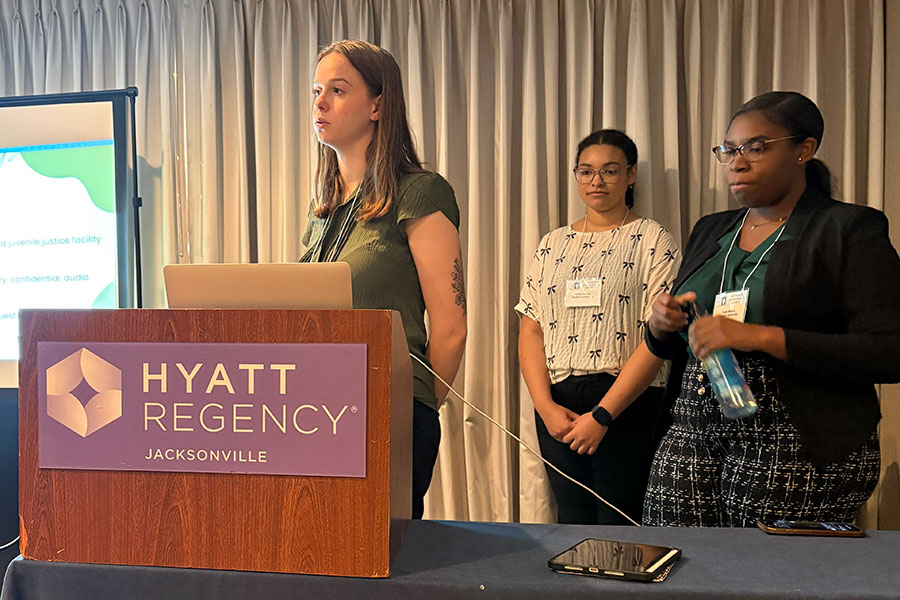
In the spring semester, Ferguson, Moore and Brown each presented their work from the research at national conferences. While Brown presented alongside Semprevivo at the American Criminal Justice Society (ACJS) in Philadelphia, Pennsylvania, in March, all three students presented the work in April at the regional Southern Sociological Society conference in Jacksonville, Florida.
“I never imagined myself being in the position to go to a conference as an undergrad,” Ferguson said. “It’s kind of like … pinch me.”
Back in her office a couple of weeks later, Semprevivo looked and smiled at the picture she took of the tomato plant the young boy tossed onto the razor wire. “I’ve always been so passionate about kids, and I just love working with them,” she said. “I learned at a very young age how pure their joy is and how pure and deserving every child is. I love their joy, and I love advocating for them.
“I want them to feel empowered, even in the darkest places.”