Here’s a highly unscientific statistic that probably won’t surprise you: A whole lot of guys like sports.
Bunches of them like to play it, and even more of them like to watch it, and when it comes to the young hopefuls now studying for a career in athletics – specifically in sport management – the majority of them are male.
According to the Journal of Sports Management and Sport Management Review, of the total students currently majoring in that field across the United States, women represent just 20% to 40%.
Reagan Adams is among that minority, but she’s on a quest to bring a little more balance to those numbers, at least at Radford.
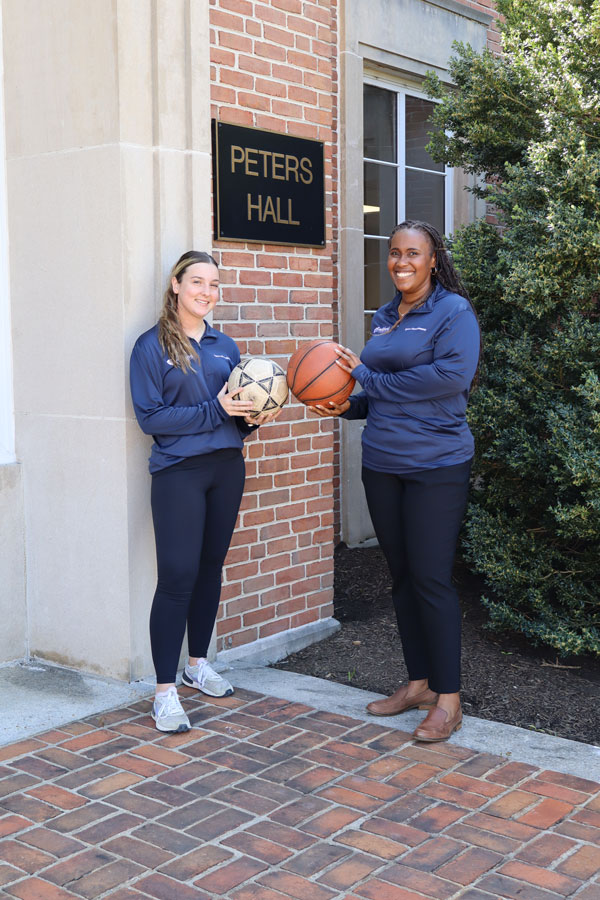
A rising senior from Richmond, Virginia, Adams is conducting a Summer Undergraduate Research Fellowship project called “Classroom to Career: Navigating Gender Bias in Sport Management.” Its goal is to determine the extent to which sport management students and alumni experience gender bias, in classrooms as well as in the workforce, and to try to develop methods to address and manage it.
“I think because I’m one of the very few girls in the major, that was something I wanted to see if we could fix, and to see how we could get more girls to join the program,” explained Adams, who’s also the president of Radford’s Sport Management Club.
She first started looking into the issue last year, working with her faculty mentor, Associate Professor of Health and Human Performance Tiesha Martin.
A shelf in Martin’s office is lined with recently minted Barbie dolls that depict the iconic character holding jobs in athletics – a coach, a referee, a sports reporter – a cultural factor she said helps fortify the convictions of girls and young women that they, too, can step forward in such a crowded field.
Using a questionnaire based on researcher Amy Diehl’s “Gender Bias Scale for Women Leaders,” Adams and her mentor conducted interviews – one-on-one, as well as with focus groups – talking to students and alums, each of them women with an interest in athletics as a profession, as well as some who have already made it their career.
During their first focus group, Martin said, “We did not get through all 20 questions because they were all really excited to talk to each other, which says something about the work that we’re doing and how a lot of those participants don’t get the chance to talk about it.
“That’s an opportunity to build community, which is a part of combating some of the gender bias or at least helping women feel like they’re together in this kind of thing. And we wanted our focus groups, in a way, to connect our current students with our alumni who may be experiencing some similar things.”
Adams concurred: “A lot of the students really appreciated being able to have female mentors and opportunities to actually connect with other women in the industry, because it is so male-dominated.”
They recorded those conversations, transcribed them and analyzed them for common themes and gender biases in the forms of hostile work environments, sexual harassment and even women in conflict with other women.
Adams has now taken ownership of the project and will use it as the foundation for an independent study and her Honors College capstone. She’ll be analyzing her data and devising her conclusions across August and September. And by early next year, she hopes to stage an even bigger gathering of women on campus, to include local high school students.
“I’m just trying to find ways we can improve programs for girls, so they won’t feel like a minority in the class and can feel like they belong,” she said.
It’s a work in progress, of course. Martin said that during the spring semester, of Radford’s 108 sport management majors, only 14 were women.
“I was looking at my roster of my classes for the fall, and there’s one course where there is one single female in the class,” she said. “I know it’s never going to reflect the university population, because I think we’re at like 60-40, male to female, and there’s no way the sport management program is going to be that, but maybe just a little bit.
“Based on the data that we collected and some of the conversations that we had with our alumni and current students, there is a need to build community and to see a career in sports as a viable option.”
In the meantime, statistical adversity hasn’t slowed Adams down. She’s spent her summer working in sports, both as a counselor at YMCA Camp Thunderbird in Chesterfield, Virginia, and as a fan services associate for the Richmond Flying Squirrels minor league baseball team at CarMax Park.
“I work directly with the fans there, just answering any questions they may have about their tickets or finding things in the park,” Adams said. “I’m there through the entirety of the game, unless I’m sent home early, which doesn’t happen often. If I’m working every game day, it’s about 36 hours a week.
“My dream job would be to work with a Banana Ball team, like the Savannah Bananas,” an exhibition professional baseball league, she said. “I have to do an internship in the spring of my senior year, and my hope is to be able to do it with them. If I could have a job right after my internship, and if I could do it with them, I would love that. And then I would like to eventually move on to Major League Baseball and work for the Atlanta Braves … I grew up a Braves fan.”
Whatever Adams winds up doing, she hopes it’s something active.
“I honestly don’t think I’m made for an office job,” she said. “I can’t sit and stare at a screen all day.”