Our Highlanders are using their education to do extraordinary things. In this column, we highlight some notable mentions from local, regional, national and international news media. Whether our students, alumni, faculty and staff are featured as subject matter experts in high-profile stories or simply helping make the world a better place, we’ll feature their stories.
Business, casual
Two years ago, as Donna McCloskey interviewed to become the new dean of the Davis College of Business and Economics, she noticed something unique about Radford’s selection process.
“I had my first Zoom interview with them, and they had students on the committee for hiring,” she recently recalled.
“Every school says that they are student-oriented, but … having students participate in the search process shows a level of student commitment that you just don’t see everywhere. And they don’t think that’s particularly special. That is just who they are.”
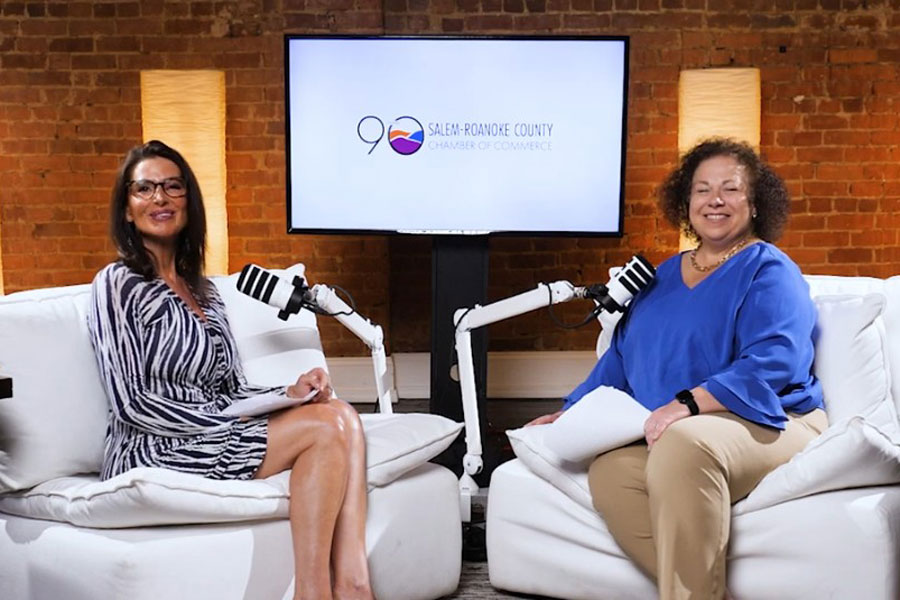
McCloskey recently shared that story, and several others, in a different kind of interview – her June 23 appearance on the Salem-Roanoke County Chamber of Commerce’s podcast, “The Pulse.”
Across the lively half-hour chat with host Amanda Livingston, McCloskey discussed an array of topics, including Davis College’s new Financial Success Center and its AI Sandbox; the university’s local business partnerships and goals; and how, early on, she shifted away from a career in law and into higher ed following an unexpected stint as an instructor.
“I loved being in the classroom,” she remembered discovering. “I just loved teaching.”
The dean also offers viewers her overall philosophy for student success at Radford.
“Work hard, play hard, and graduate on time with a job,” McCloskey said.
Going back to Nashville
During a trip to Nashville last year, a dozen of the Davis College Fellows got the chance to meet with a host of professionals and Radford alums.
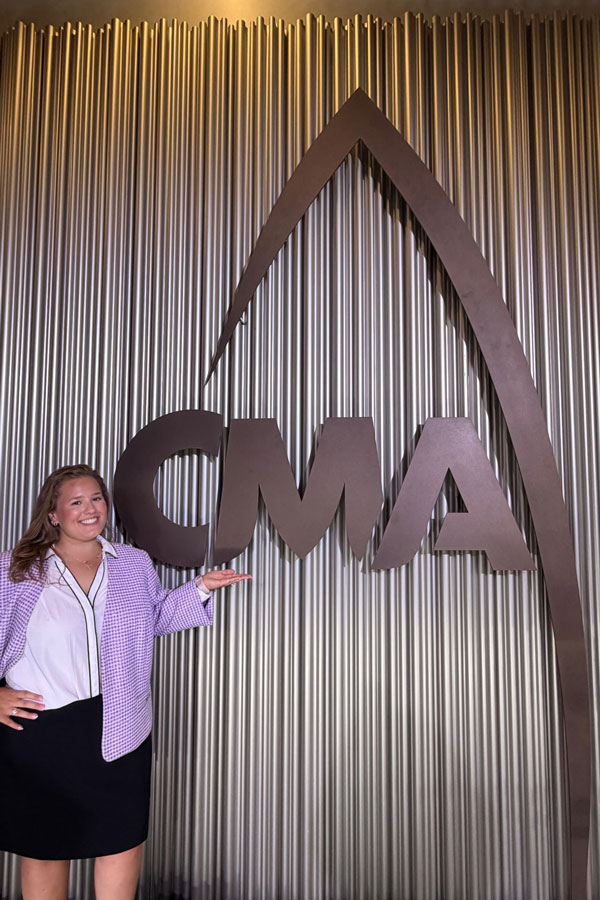
One of those student visitors was Shannon Herrity, a marketing and management major who minors in music industry studies, and who spent some of that Tennessee time consulting with a longtime entertainment attorney who’s worked with record companies like Capitol and DreamWorks.
Flash forward one year: July found Herrity right back in Nash-town, serving as Radford’s representative at the Country Music Association’s CMA EDU Class of 2026-2027.
That’s a three-day summit in which students from just 24 universities across the country took part in professional development opportunities and music industry education and got some face time with artists and executives now embedded in the biz.
"My experience at the CMA EDU Leadership Summit was nothing short of amazing,” Herrity told us upon her return. “I was able to hear from several music industry professionals and connect with other students from across the country that are just as passionate about the business as myself.”
In a release about the event, Tiffany Kerns, a CMA senior vice president, described CMA EDU like this: “The vision was to bring students and industry professionals together in one place, and to give emerging leaders access to the people, perspectives and relationships that can shape an entire career.”
You can see the full schedule of events Herrity took part in, and the long list of participants in the news release on CMA’s website.
Excellence in her field
A radiation expert and Radford alumna is this year’s recipient of the Elda E. Anderson Award, which is conferred on members of the Health Physics Society for their advances and their support in that field.
Caleigh Samuels ’10 was cited by the HPS for “her excellence in research, devotion to health physics and significant contributions to our profession.”
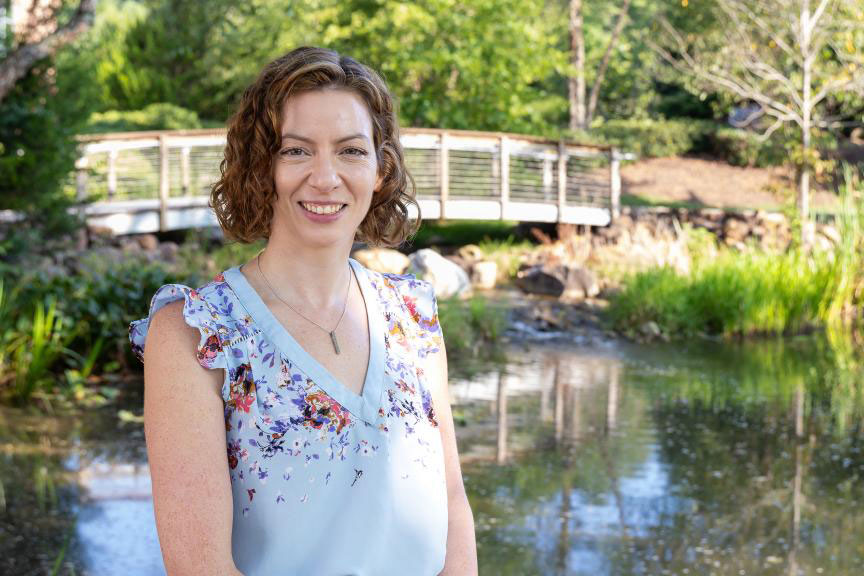
The group said Samuels, a lead dosimetrist for the Center for Radiation Protection Knowledge at the Department of Energy’s Oak Ridge National Laboratory – or the CRPK at ORNL – works in biokinetic modeling, risk assessment and radiation transport and has participated in the Million Person Study, “which analyzes the health effects of low-level radiation exposure across a broad range of workers.”
Samuels earned her bachelor’s degree in physics from Radford University; she later received her master’s in medical physics and her doctorate in nuclear engineering, both from the Georgia Institute of Technology.
The full details of Samuels’ work, qualifications and award can be found in this July 21 Mirage News story, and Oak Ridge published this profile of Samuels in December 2025.
According to the latter article, Samuels was raised in a household captivated by scholarship; her father was an expert for the U.S. Food & Drug Administration, while her mother studied chemistry with a focus on food safety.
“There wasn’t a chance I wouldn’t be a scientist,” Samuels said.
Eyes on the future
Artificial intelligence is already reshaping businesses and workforces, but where is it all going and what’s our future with it going to look like?
That’s a question both exciting and anxiety-inducing, and one whose answer remains elusive for now, but a new initiative by Radford University seeks to gain some clarity.
A July 7 story by Radio IQ/WVTF looks at the $97,000 grant the school recently received from the Appalachian Regional Commission (ARC) for the purpose of gauging the ways in which AI might alter career paths.
Founded in 1965, ARC works to cultivate economic development in the Appalachian region.
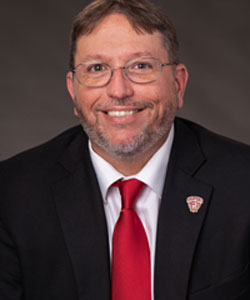
Reporter Roxy Todd spoke with computer science Professor Prem Uppuluri, who’s involved in the research, as well as Tom Bennett, a senior director with Radford’s Economic Development and Corporate Education division.
“It’s very clear that most employers and most companies are going to use AI,” Uppuluri told Todd. “But the question is, would AI actually be effective? And how much human intervention do you actually need?”
Bennett said in the piece that they’ll seek additional grants to fund training curricula to help workers and employers process the skills industries may soon require and strategize to meet those needs.