Summer breaks are a foreign concept to Lily Backus.
She never stops learning. She never stops exploring. She simply never stops.
“Lily just wants to learn things and be a part of them,” said Radford University Associate Professor of Physics Sandy Liss, who knows Backus well. “That’s who Lily is.”
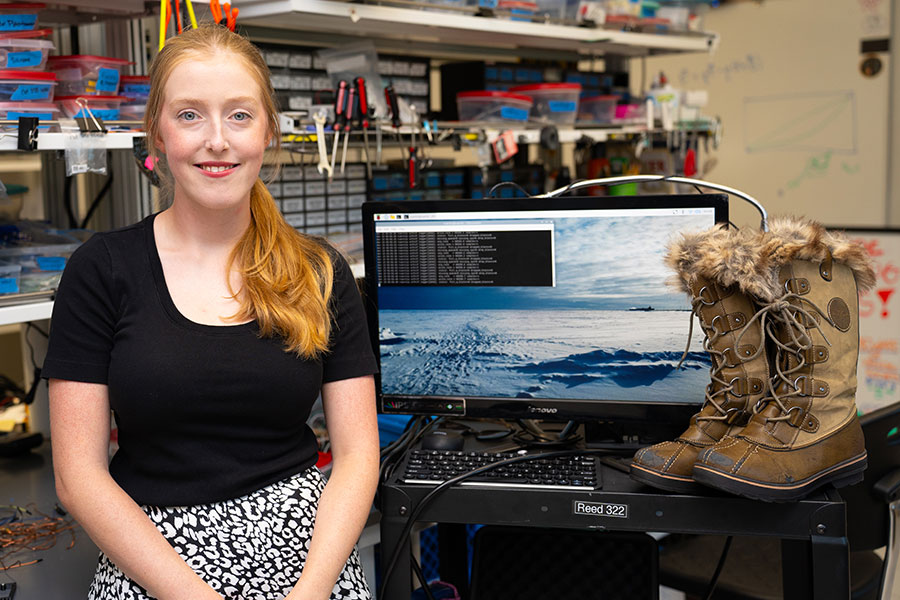
This past summer was no exception to Backus’s don’t-stop disposition. She spent 10 weeks interning at the U.S. Naval Research Laboratory (NRL) in Washington, D.C. There, the senior physics major built upon the research experience and technical skills she had developed during her first three years at Radford while gaining experience working in a professional research environment.
Her work at NRL on low-noise amplifiers was similar to the research project she developed last year, when she received a Radford University Artis College/AEP Summer Research Fellowship. That award allowed the Suffolk, Virginia, native to remain on the Radford campus in the summer to focus on and advance the research she would deploy months later during the biennial geophysics journey to Utqiagvik, Alaska, the following February and March.
During that summer of 2025, Backus educated herself on extremely low frequency (ELF) and very low frequency (VLF) electromagnetic waves and the hardware that is required to send and receive those waves. She even developed her own Raspberry Pi system to support the process. In the Radford Arctic Geophysics lab, she constructed an antenna with 14- gauge wire, PVC pipe and 6-foot-long wooden dowels. Backus further developed her skills in soldering, circuit building and coding in Python and C for higher-level and lower-level operations of the Raspberry Pi. It was difficult and challenging work, but it all seemed to come together in the summer and fall of 2025 in time to test the project in Alaska.
However…
On the flight to Utqiagvik, Backus realized that the real-time clock implementation in her Raspberry Pi-based system would not properly adjust to the four-hour difference from Virginia to Alaska time. What she initially thought would require a simple timing adjustment ultimately exposed deeper problems with the system's data handling, forcing Backus to substantially overhaul the code after arriving in Alaska.
“I was like, ‘Oh, no, it’s not ready,’” she recalled thinking on the plane.
Fixing the issues was “way more complicated than changing some clock values,” explained Radford Professor of Physics Rhett Herman, who leads the Arctic research experience. “Lily pulled two all-nighters when she arrived in Alaska,” before her project was ready to deploy.
Backus also had to adapt to extreme-cold battery issues. Fortunately, substantial packing foam used to protect computer monitors and other fragile equipment on the trip to Alaska – including Natural Log, the famous mascot of Radford's Society of Physics Students – found a second purpose insulating her equipment from the cold. February wind chills in Utqiagvik can regularly dip to −35 Fahrenheit and colder, but Backus soon was able to collect several gigabytes of data each day, and “a whole world opened up for her research,” Herman explained.
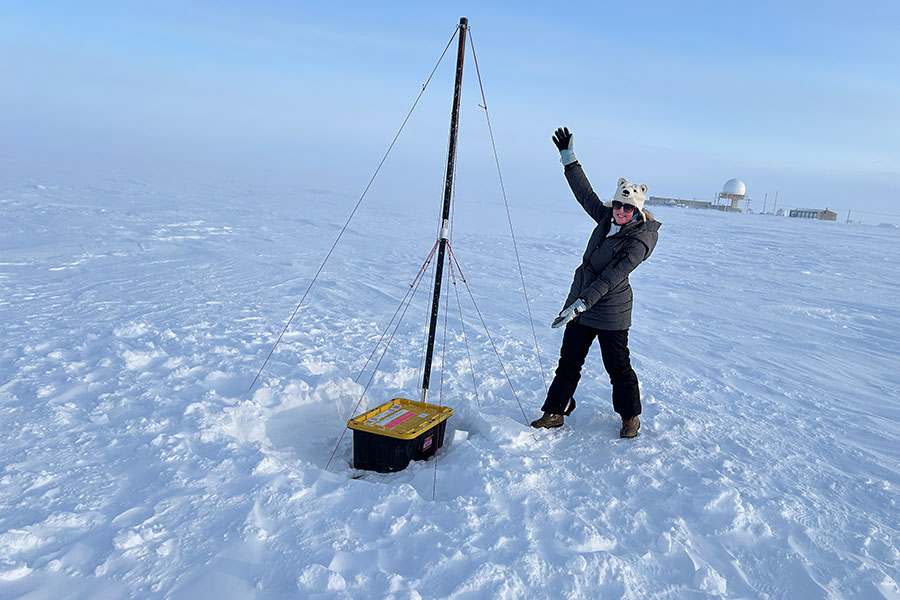
Most students who participate in the Arctic geophysics journey typically stay for one week. Backus, however, stayed for the full two weeks, trying to perfect ionospheric antenna design for her space weather-related research. She was very grateful, she explained, for the extra time to make sure her project could be as successful as it could be.
“I definitely feel like that experience gave me a leg up in preparing for the amazing opportunity I had this summer at Naval Research Laboratory in Washington, D.C.,” Backus said.
Her extra efforts throughout the summer and all the way to Alaska paid off when it came to applying for the internship. In fact, her extensive résumé raised a few discerning eyebrows from individuals at NRL, and left them asking:
Did Lily Backus do all the work she claimed on her application?
“They contacted me and Dr. Liss to determine, first, that Lily really had done all of the things that she had put on her extensive résumé,” Herman recalled. “When we confirmed that, the second thing they asked was whether she really was an undergraduate student. This was because she already had a graduate student’s résumé, as a college junior.”
Yes, Liss confirmed to NRL, “This is who Lily is.”
Once her résumé was confirmed, Backus secured the NRL internship that’s typically awarded to graduate students, “and post-docs,” Herman noted, “not undergraduate students.
“Absolutely amazing,” the professor added.
Backus began working with Radford faculty on research projects the same way many young scientists do at the university, through the Highlander Research Rookies program. “It was a great introduction to research, not only learning how research works,” she explained, “but also making connections with faculty in my department and developing my own research interests.”
Establishing connections with faculty was a deciding factor that led Backus to select Radford over other colleges and universities for her undergraduate journey. As a high school senior, she reached out and interviewed on Zoom various physics faculty at schools throughout Virginia where she had applied.
“I immediately clicked with Dr. Herman,” said Backus, smiling, displaying her vibrant personality. “That connection continued with Dr. [Sandy] Liss through follow-up emails, classes and eventually research.”
Radford's smaller class sizes and energetic emphasis on undergraduate research were other major factors in Backus’s decision. “I immediately felt that I would have more opportunities to develop relationships with faculty, become involved in research early and grow as a scientist without being lost in a much larger and more competitive undergraduate environment.”
Those factors were particularly important to Backus, “as a deaf student,” she said. “Being deaf has deeply influenced my academic journey in ways that are difficult to separate from the rest of who I am.”
Backus sometimes wonders how her life and academic pursuits would have been different had she been born hearing. Perhaps, she said, she would have pursued more foreign languages and international experiences.
“At the same time,” Backus noted, “dealing with those challenges from such a young age gave me an intensely dedicated focus on becoming self-sufficient.
“There have even been periods when I've gone weeks without wearing my cochlear implants,” she continued. “Like when I'm sick, extremely stressed, studying for major exams or completely in the trenches with research. And it has never prevented me from participating in my academic work.”
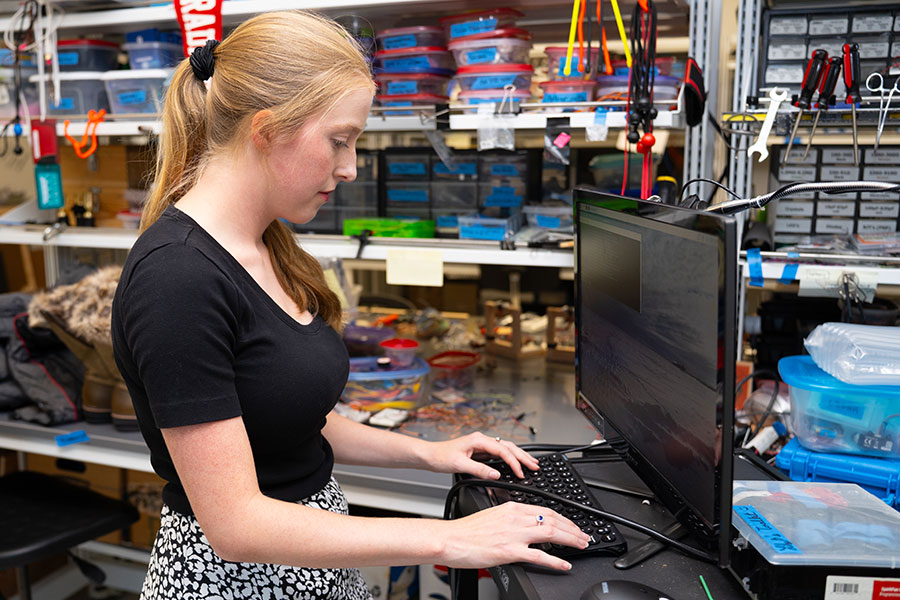
At Radford, Backus explained, she’s never had to navigate the challenges of her academic journey alone. She’s worked with the university’s Center for Accessibility Services (CAS) to formalize accommodations such as preferential seating, captions or subtitles for videos and one-on-one office-hour support when needed.
Radford’s Center for Accessibility Services works with students “through an interactive process to identify reasonable accommodations that provide equitable access to the university experience,” said Brittany Oliver, CAS coordinator of Deaf and Hard of Hearing. “Our goal is to provide access and empower students to advocate for their needs while developing skills they can take with them beyond college.”
Backus certainly has gone above and beyond.
Throughout her academic journey, she has found a small and caring American Sign Language (ASL) community at Radford, which has led to supportive friendships and some pretty competitive Dungeons & Dragons campaigns.
The Radford faculty Backus has worked with, she said, have been real “superstars” as she navigates through her Highlander experience. In addition to their day-to-day support, some have asked her to teach her fellow students fingerspelling, which led them to use handshapes for A, B, C and D to answer multiple-choice questions during class discussions.
“Little moments like that,” Backus said, “have been really sweet and have made Radford feel welcoming.”
She’s felt welcome to explore a variety of opportunities at Radford, including volunteering to work with Herman at the Radford Planetarium and with Liss at the Selu Observatory. Backus has also worked with the university’s Summer Bridge and BLAST programs, helping introduce middle and high school students from across Virginia to STEM through hands-on activities and experiences, “such as crazy rocket launches!” she said.
That interest in outreach has extended beyond Radford. Backus encourages fellow physics students to participate in the Society of Physics Students’ yearly January trip to the Green Bank Observatory in West Virginia’s National Radio Quiet Zone. There, she and each student on the trip operated the observatory’s 40-foot teaching radio telescope that had been originally built by Frank Drake of "Drake Equation" fame, the equation that estimates the number of active, communicating civilizations in our galaxy. Backus later returned to Green Bank to volunteer as a counselor for the observatory’s summer camp.
“I tell people [Radford students] if you go to Green Bank and make connections, you might have a really awesome summer,” Backus said, beaming as she spoke about her experiences of another busy and fulfilling summer. “You never know what could happen from the networks that you build.”
Those connections could play a pivotal role for Backus after she graduates from Radford in the spring of 2027. She has plans to apply for doctoral programs to study space weather.
Space weather?
Yes, “space weather is basically the study of how activity from the sun affects the environment around Earth and our technology,” Backus explained. “Things like solar flares and geomagnetic storms can affect satellites, communications, GPS and even power systems here on the ground.”
It combines many elements Backus wants from her career. It’s “applied physics,” she explained, expressing a desire to work, not spending her whole life behind a desk, but partly within the field, perhaps in places around the world such as Antarctica and the Arctic, where she already has hands-on experience conducting research in sub-zero temperatures.
The space weather discipline, too, requires a specialized set of skills, and “there aren't that many people who develop expertise in all of them,” Backus explained. “I've realized that I'm continually building the skills to become one of those people, which is really exciting.”
Backus found her way to space weather because, as she explained, “Radford gave me the space, mentorship and opportunities to develop enough as a researcher that I could pursue them. I really like that Radford allows you to find your passion in research and grow and find your place here. I'm forever grateful for the opportunities Radford gave me.”
Her faculty mentors are grateful, too, for their experiences of knowing and working with Backus.
“I don’t want Lily to graduate,” Liss said. “She’s so knowledgeable, and she’s a wonderful mentor to our other physics majors. I just want her to stay with us forever.”