It’s been less than a year since Radford University’s Center for Applied Analytics rebranded itself, and in that time, the facility has quickly fortified its goal of helping students and faculty navigate new realms of technologies and providing in-depth analyses of systems and data.
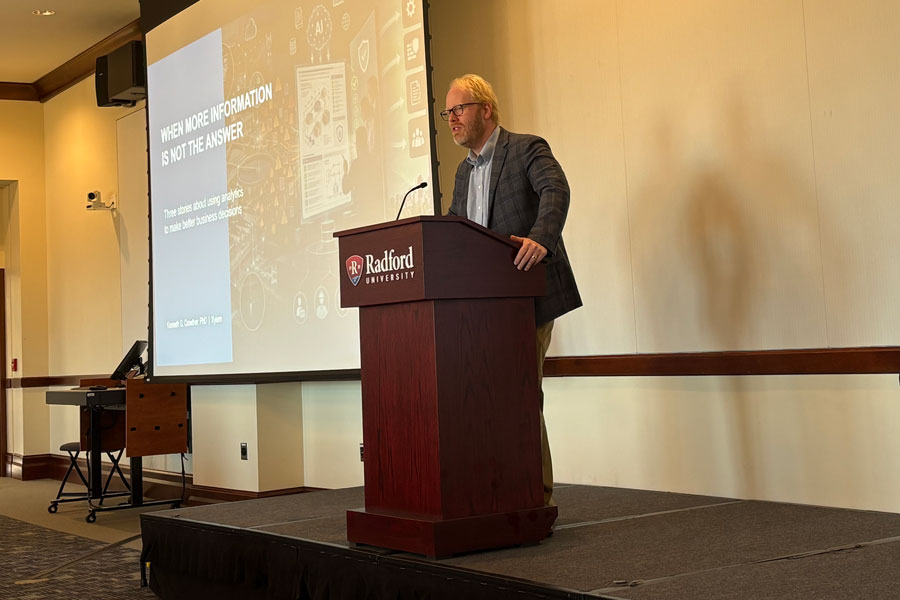
Associate Professor of Management Zach Collier was named the center’s director in December, and it was officially relaunched in mid-March with a gathering that featured guest speaker Ben Trump, the president of the Society for Risk Analysis (SRA) and the head of Tor Intelligence LLC, an applied analytics firm based in Raleigh, North Carolina.
This semester, on Oct. 29, the center welcomed its second speaker, Kenneth Crowther, a product security leader with Xylem, the Washington, D.C.-based global water technology company.
Collier said the analytics center will continue to bring in two visiting lecturers a year, one in the fall and another in the spring, with an eye trained on diversity within the field.
“By bringing in speakers from different industries and with different job functions, we hope to show students how they might be able to use analytics within their own careers and the wide array of opportunities that exist to solve real business problems through applied analytics,” Collier said. “Hopefully they can connect the messages from the speakers with topics that they have been learning in class.
“In general, we want to highlight speakers from a broad array of industries, and especially those that are aligned with the Davis College of Business and Economics’ strategic goals,” he explained.
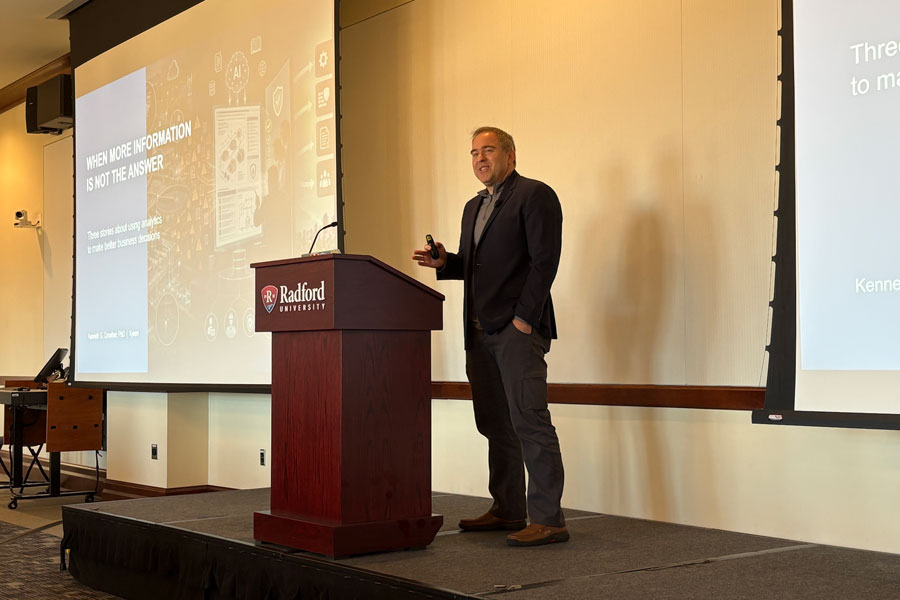
In Crowther’s recent lecture, he covered a range of topics, but one key point he stressed is that in business, data analysis is counterproductive unless it actually helps humans make faster, better-informed decisions. Advances in technologies like AI, for example, can often leave developers spoiled for choice.
He cited examples like “the 3 vs. 300” dilemma – polling audience members on whether they would rather be given three options in a particular decision or 300, and exploring the pros and cons of both paths – as well as “the 400 problem,” in which AI evaluation tools raise hundreds of potential issues that could be addressed during production, thus creating a more comprehensive list but one that’s also likely to overwhelm engineers.
At the heart of these circumstances, beyond the data gathering, lies the age-old business challenge of speed versus perfection.
“I’m a product security leader, which means that my job is to create a program with a set of processes that are all secure,” Crowther said. “We have over 1,000 products that have some kind of digital capability inside them, and all of these products have something to do with water technology. And so, as you can imagine, that means they need to have a certain level of security inside.
“But what happens is, every month that we delay a product release, that results in lost market share, which translates to sustained revenue loss across the entire lifetime of a product. But if we go ahead and release the product and then end up finding a vulnerability … it costs about 500 times [more] to patch that vulnerability.”
Finding a happy medium between those two poles is still a work in progress for most, but technological advances are bringing it closer to reality.
One partial solution that businesses can employ in the interim, Crowther said, has distinctly more of a human touch.
“When we want to know what to do, we've got to ultimately find out from our customers. What aspects of cybersecurity do they actually care about?” he said.
Gathering data from customers can be a complicated process, but it helps pare down inputs and leads to a more useful set of outputs.
The ultimate goal of the analysis is to determine two things from the customer: “What is highly important to you?” and “What is the market failing to give you right now?”
“If we don't do this up front, we're going to end up gathering a lot of data, and it's not going to be relevant to any of the decisions that we make,” Crowther said.
Collier said plans are already in the works for the center’s lecture next semester.
“Our speaker in the spring is going to speak about the analytics of public health,” Collier said.
Radford University’s Center for Applied Analytics is located in Kyle Hall Suite 231.