Radford University
Communication Sciences and Disorders
- Degree Type
-
- Master of Arts, Master of Science
- Location
-
- Main Campus in Radford, VA
- Format
-
- In-Person
Join us for Virtual Information Sessions!
Connect with faculty and current students while you ask about our 2-Year and 3-Year master's degree programs, admissions process and opportunities. Information sessions are being held on the following dates:
- Monday, October 26 at 7 p.m.
- Monday, January 11 at 7 p.m.
Overview
Launch your future in speech-language pathology through a program built around early clinical experience, close faculty mentorship, and real-world learning from day one. Our M.A. and M.S. programs in Communication Sciences and Disorders are designed to support both traditional students and career changers, even those without a prior CSD background, in a collaborative environment where students are known, supported, and professionally prepared. With a streamlined pathway that can be completed in as few as five semesters, you can enter a high-demand field faster with the confidence and experience employers value.
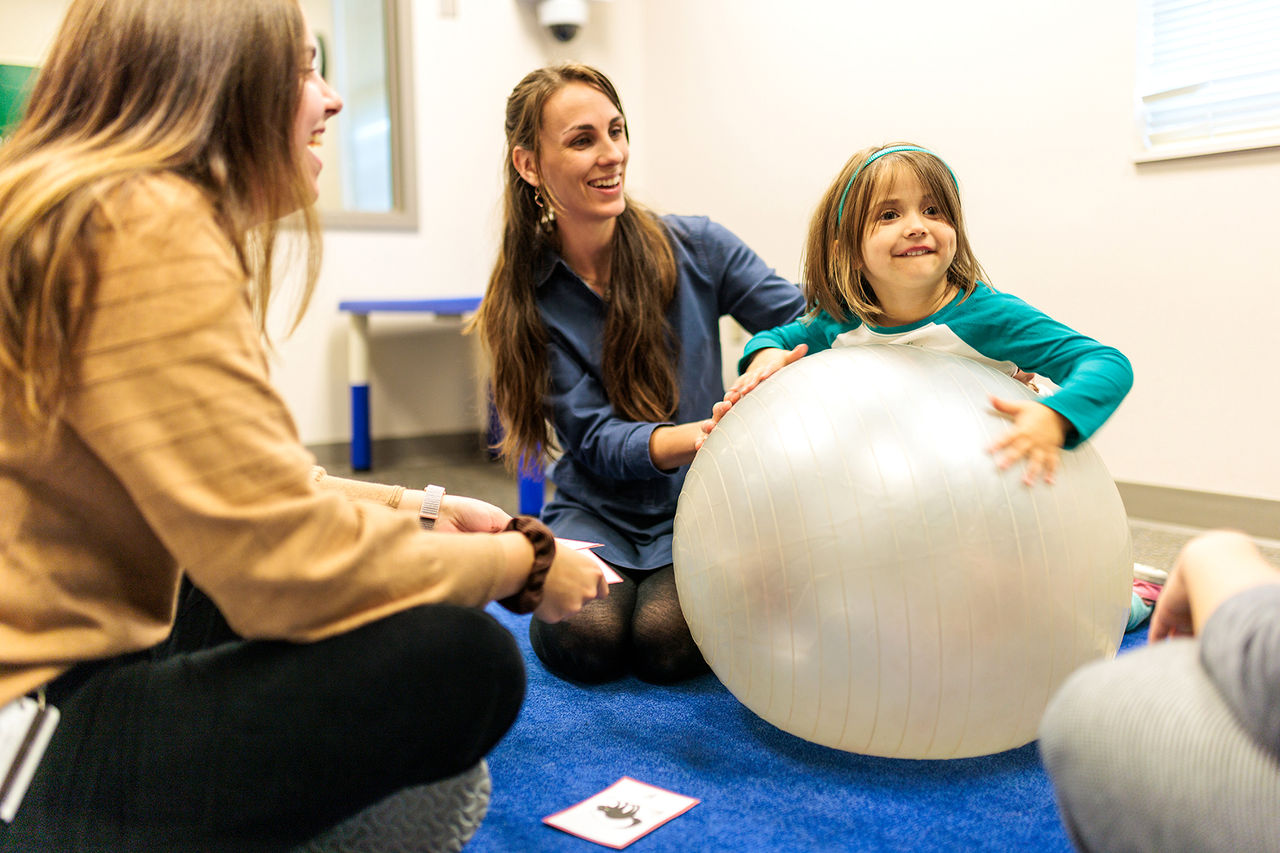
Why Study Communication Sciences and Disorders at Radford University?
At Radford University, you won’t just study speech-language pathology; you’ll begin living it from the start. With nearly 200 clinical externship sites nationwide, students gain hands-on experience in diverse settings while having the flexibility to complete final fieldwork locally or pursue opportunities across the country based on their personal and professional goals.
Our accredited M.A. and M.S. pathways are designed for both traditional students and career changers, offering a streamlined two-year track for students with prior CSD coursework and a three-year pathway for those entering from other academic backgrounds. Through close faculty mentorship, personalized clinical placement support, and a collaborative learning environment, graduate students prepare to enter a high-demand profession with confidence and real-world experience.
We believe exceptional future clinicians are defined by more than numbers alone. That’s why our holistic admissions process considers academic achievement alongside personal experiences, attributes, and professional readiness to identify students who are compassionate, driven, and ready to make a difference.
Degrees Offered
Master of Arts
with a concentration in Speech-Language Pathology
- A thesis is a requirement for the Master of Arts degree. An oral defense of the thesis is required during the last semester of enrollment.
Master of Science
with a concentration in Speech-Language Pathology
- Master of Science candidates are required to pass a final written comprehensive examination during the last semester of enrollment. The Graduate Program Coordinator will provide additional information regarding requirements for the comprehensive exam at the start of the program.
Two Year Track
The department’s graduate concentration in Speech-Language Pathology is accredited by the Council on Academic Accreditation (CAA) of the American Speech-Language-Hearing Association (ASHA).
The program offers academic and clinical curricula that provide students with the knowledge and skills required for the Certificate of Clinical Competence in Speech-Language Pathology (CCC-SLP). This nationally recognized professional credential is issued to individuals who present evidence of their ability to provide independent clinical services to persons who have disorders of communication.
The program’s curricula also provide students the opportunity to meet the requirements of the Virginia Board of Audiology and Speech-Language Pathology for licensure in speech-language pathology.
Three-Year Leveling Track
Students who have not earned an undergraduate degree in Communication Sciences and Disorders are encouraged to apply for the 3-year leveling track. This option allows students to complete 28 credit hours of supporting coursework in the first year of study prior to transitioning into the graduate course sequence. Students accepted into the three-year track have graduate student status and must remain in good standing.
After completion of prerequisite coursework, "levelers" will transition into their graduate course sequence for either the Master of Science track or the Master of Arts track.
|
Required Courses |
Credit Hours |
|
COSD 301. Anatomy and Physiology of the Speech, Language, and Hearing Mechanism |
3 |
|
COSD 323. Speech Science |
4 |
|
COSD 330. Introduction to Audiology |
3 |
|
COSD 421. Language Development: Birth to Five Years |
3 |
|
COSD 425. Later Language Development |
3 |
|
COSD 438. Phonetics |
3 |
|
COSD 454. Speech-Language Disorders: Prevention and Assessment |
3 |
|
COSD 455. Speech-Language Disorders: Intervention Methods and Application |
3 |
|
COSD 459. Introduction to Articulation and Phonology |
3 |
Official undergraduate transcripts and syllabi must be submitted for review to determine course deficiencies. Programs of study may vary depending on individual prerequisite deficiencies as determined by the graduate program coordinator and COSD faculty as appropriate.
Master of Arts Degree Requirements
Master of Science Degree Requirements
Careers and Internships
The Communication Sciences and Disorders master’s degree helps you gain the skills
to prepare for a variety of possible work environments and settings, including hospitals,
acute care, outpatient, skilled nursing, long-term care, schools, and private practices
as a speech-language pathologist.
Speech-language pathology ranks #9 in the top 100 Jobs and #3 in Best Healthcare Jobs
in the US News and World Report (2025). Not only is it one of the top-ranked career
paths, but also the job outlook for speech-language pathologists is 18% growth from
2023 to 2033. The median pay in 2024 for SLPs in the US was $95,410 (US Bureau of
Labor Statistics).
Learn more about speech-language pathology career insights and outlook.
Students complete their first three semesters of clinical practicum in the Radford University Speech-Language-Hearing Clinic. During these first three semesters, clinical training is provided by the COSD faculty
at the on-campus clinic. For the last two semesters of the graduate program, students
are assigned to external practicum sites and receive their clinical training from
ASHA certified speech-language pathologists. We currently have 190 externship sites
across the nation.
Licensure
Speech-language pathology
The Communication Sciences and Disorders (COSD) graduate program is accredited by
the Council on Academic Accreditation in Audiology and Speech-Language Pathology (CAA)
of the American Speech-Language-Hearing Association. The graduate program provides
students the opportunity to achieve the knowledge and skills outcomes required for
the Certificate of Clinical Competence in Speech-Language Pathology (CCC-SLP) through ASHA once they have successfully completed a post-graduate clinical fellowship
totaling 1260 hours and passed the national certification exam in speech-language
pathology obtain the certification. ASHA certification meets or exceeds state licensing
requirements in all 50 states
Some states require additional clinical or educational requirements to work in the
school systems beyond the ASHA-CCC-SLP such as a minimum number of clinical hours
training in a school system or additional coursework. These requirements can be met
while enrolled in the graduate program at Radford University through individualized
academic advising and fieldwork placement. States with additional SLP licensing requirements
to practice in the schools include: Arizona, California, Connecticut, Florida, Illinois,
Iowa, Massachusetts, Nevada, New York, and Wisconsin. More information about national
certification requirements can be found at www.asha.org/advocacy/state/. Please refer to the table below, which indicates for each state whether completion
of the program alone meets the educational requirements for licensure.
| State | Determination |
| Alabama | meets |
| Alaska | meets |
| Arizona | does not meet |
| Arkansas | meets |
| California | does not meet |
| Colorado | meets |
| Connecticut | does not meet |
| Delaware | meets |
| Florida | does not meet |
| Geogia | meets |
| Hawaii | meets |
| Idaho | meets |
| Illinois | does not meet |
| Indiana | meets |
| Iowa | does not meet |
| Kansas | meets |
| Kentucky | meets |
| Louisiana | meets |
| Maine | meets |
| Marland | meets |
| Massachusetts | does not meet |
| Michigan | meets |
| Mississippi | meets |
| Missouri | meets |
| Montana | meets |
| Nebrasks | meets |
| Nevada | does not meet |
| New Hampshire | meets |
| New Jersey | meets |
| New Mexico | meets |
| New York | does not meet |
| North Carolina | meets |
| North Dakota | meets |
| Ohio | meets |
| Oklahoma | meets |
| Oregon | meets |
| Pennsylvania | meets |
| Rhode Island | meets |
| South Carolina | meets |
| South Dakota | meets |
| Tennessee | meets |
| Texas | meets |
| Utah | meets |
| Vermont | meets |
| Virginia | meets |
| Washington | meets |
| West Virginia | meets |
| Wisconsin | does not meet |
| Wyoming | meets |
Clinical Practicum
Programs of study are developed so that each student has the opportunity to acquire the academic knowledge and clinical skills needed for ASHA certification. In the Radford University COSD program, students acquire a minimum of 375 clinical clock hours of supervised practicum during their graduate studies. Most students actually complete more than the minimum number of hours required for ASHA certification.
Typically, students complete their first three semesters of clinical practicum in the Radford University Speech-Language-Hearing Clinic. During these first three semesters, clinical training is provided by the COSD faculty at the on campus clinic. For the last two semesters of the graduate program, students are assigned to external practicum sites and receive their clinical training from ASHA certified speech-language pathologists.
Students can learn more about the professions of speech-language pathology and audiology, including requirements for professional certification, by visiting the website of the American Speech-Language-Hearing Association (ASHA).
Clinical Externship Sites
- Adler Therapy Group
- Adventist Rehabilitation Hospital of Maryland
- Aegis Therapies, Inc.
- Alleghany Health District
- Allegheny Health Network
- Alliance Physical Therapy Group, LLC
- Ashe County Schools
- Augusta Health
- Aveanna Healthcare
- Ballad Health
- Bedford County Public Schools
- Benchmark Rehabilitation Partners, LLC
- Benchmark Therapies, Inc.
- Blue Mountain Therapy, LLC
- Blue Ridge Therapy Associates
- Botetourt County Public Schools
- Buford Kids’ Spot, LLC
- Carilion Clinic
- Carolina HealthCare System
- Caroline County, Maryland Public Schools
- Center for Pediatric Therapies, Inc.
- Centra Health
- Charleston County School District
- Charlotte-Mecklenburg Public Schools
- Charlottesville City Schools
- Chelsea, Michigan School District
- Chesapeake Virginia Public Schools
- Cheshire Center
- Child Development Resources
- Children's Hospital of The King's Daughters, Inc.
- CHS Therapy, LLC
- Cincinnati Children's Hospital Medical Center
- Clark-Pleasant Community Schools
- Coastal Virginia Rehabilitation, LLC
- Coastline Therapy Group
- Continuum Therapy Partners
- Craig County Child Care Center
- Craig County Department of Social Services
- Craig County Public Schools
- Crawford Central Pennsylvania School District
- EBS Healthcare
- Encompass Health Rehabilitation Hospital of Cardinal Hill, LLC
- Encompass Health Rehabilitation Hospital of Fredericksburg, LLC
- Encompass Health Rehabilitation Hospital of Kingsport, LLC
- Encompass Health Rehabilitation Hospital of Largo, LLC
- Encompass Health Rehabilitation Hospital of Northern Virginia, LLC
- Encompass Health Rehabilitation Hospital of Petersburg
- Encompass Health Rehabilitation Hospital of Princeton
- Encompass Health Rehabilitation Hospital of Sunrise, LLC
- Encore Rehabilitation Services, LLC
- Fairfax County Public Schools
- Falls Church City Public Schools
- Fauquier Health
- First Quality Rehabilitation
- Floyd County Public Schools
- Frederick County Maryland Public Schools
- Friendship Health & Living Community
- Frye Regional Medical Center
- Galax City, Virginia Public Schools
- Galax Department of Social Services
- Gormas Speech Pathology, Inc.
- Grayson County Public Schools
- Greenbrier VMC, LLC
- Guggenheimer Health and Rehabilitation Center
- H2Health
- HCA Capital Division, Inc.
- HCA Healthcare - Mountain Division, Inc.
- HCA South Atlantic Division
- Heritage Hall – Blacksburg
- Heritage Healthcare, Inc.
- Highland Ridge Health and Rehabilitation
- Hispanic Services Organization of Southwest Virginia
- Innovative Healthcare Group, LLC
- Inova Health System
- Iredell Health System
- Ivy Rehab Network and Southeastern Therapy for Kids
- Jeanes Hospital
- Johnston Memorial Hospital
- Kids First Therapy
- Kissito Healthcare
- Language Fundamentals, Inc
- Legacy Healthcare Services, Inc.
- Lemont-Bromberek Combined School District (Illinois)
- Linguacare Associates Inc.
- Loudoun County Public Schools
- Madison Metropolitan School District
- Mary Washington Hospital, Inc.
- Medical Facilities of America, Inc.
- Medical Facilities of North Carolina, Inc.
- MedStar Health, Inc.
- Miami County Educational Services Center
- Mini Miracles Pediatric Therapy
- Montgomery County Public Schools
- Neuro Restorative Virginia
- Occupational Therapy Associates
- Odyssey Rehabilitation
- Pender County, North Carolina Schools
- Powerback Rehabilitation/Genesis Eldercare Rehabilitation Services, Inc.
- Prince William County Public Schools
- Professional Therapies of Roanoke
- Pulaski County Schools
- Radford City Public Schools
- Rehab Without Walls NeuroSolutions
- RehabCare
- Renewal Rehab
- Resolute Therapy
- Results Physiotherapy
- Richfield Living
- Riverside Healthcare Association, Inc.
- Russell County Public Schools
- Salem VA Medical Center
- Sea Pines Rehabilitation Hospital Limited Partnership
- Select Rehabilitation, LLC
- Sentara Hospitals
- SLC Loudoun
- Smyth County Community Hospital
- Smyth County Public Schools
- Southern Healthcare Management LLC
- Southwestern Virginia Mental Health Institute
- Speechcenter, Inc.
- Stafford County Public Schools
- Stonerise Therapy, LLC
- Surry County, North Carolina Schools
- The American Oncologic Hospital
- The Chateau at Moorings Park
- The Glebe
- The Rehab Department, LLC
- The Shandy Clinic
- The Speech and Language Center
- The Speech and Language Connection
- Therapy Talk, Inc.
- Total Communication, Inc.
- Trinity Rehab
- UNC Rockingham Health Care
- Upper Arlington Speech Therapy Services
- UVA Encompass Health Rehabilitation Hospital, LLC
- Valley Health System
- VCU Medical Center
- Vidant Health
- Virginia Beach City Public Schools
- Virginia Hospital Center
- Virginia Lutheran Homes, Inc.
- Vita Healthcare Group, LLC
- Waddell Nursing and Rehab Center
- Wake Forest University Baptist Medical Center
- Washington County, Virginia, Public Schools
- Waterman Speech-Language Pathology
- Waynesboro Public Schools
- Wilson Workforce and Rehabilitation Center
- Winston-Salem/Forsyth County Schools
- Wise County Public Schools
- Wythe County Community Hospital
Opportunities for Communication Sciences and Disorders Students at Radford
When getting your degree in Communication Sciences and Disorders at Radford, you will work closely with your professors and have opportunities to work on faculty-student research collaborations.
The experience we offer in this program is very hands-on: we have an on-campus clinic that provides training and clinical services to 60-80 adult & pediatric clients from the community each semester. Students will provide therapy in this clinic for their first 3 semesters with clinical training provided by our faculty.
Beyond hands-on learning, we have 15 graduate assistantships ($4,500 per AY) and 6 department scholarships ($5,000-7,000) to award with additional funding available.
Students in COSD can join the Radford University Chapter of the National Student Speech-Language Hearing Association (NSSLHA)
Apply for Admission
Admission Requirements
Application Deadline: February 1
Applicants must meet the following minimum requirements:
- Cumulative GPA of 3.0
- GPA of 3.0 in all major core coursework
To ensure equitable treatment of all applicants, all applications are evaluated using the same published criteria. No exceptions to the program’s admissions requirements will be made. The following components must be included for the applicant to be considered for admission:
Application to Program
Apply through the Communication Sciences and Disorders Centralized Application Service (CSDCAS):
Official Transcripts
Must be submitted to CSDCAS for verification from all institutions attended, including:
- Community colleges
- Dual-enrollment coursework
Additional guidance:
- Transcripts may be submitted before fall grades are finalized to begin verification.
- Final fall semester grades must be submitted by the February 1 deadline via an Academic Update request in CSDCAS.
- CSDCAS will not verify updated transcripts unless an Academic Update is requested.
Personal Essay
We use a holistic review process to better understand each applicant’s goals, experiences, and readiness for graduate study. Graduate education involves both pursuing professional aspirations and navigating new challenges. These prompts invite you to reflect on your goals as well as areas where you anticipate growth and may benefit from support.
Essay requirements:
- Two responses (maximum 300 words each; 600 words total)
- Single-spaced, 1-inch margins
- Font: Arial, Calibri, or Times New Roman
Prompt 1:
Describe two professional goals you hope to pursue in your career. How do you see Radford University’s graduate program supporting your progress toward these goals? In your response, highlight aspects of the program (e.g., coursework, clinical experiences, faculty mentorship, research opportunities) that align with your interests and aspirations.
Prompt 2:
Graduate study can be both rewarding and challenging. Reflecting on your transition into a graduate program, what are two challenges you anticipate encountering? For each, please describe how you plan to respond, including specific strategies, resources, or supports that will help you be successful in the program.
References
Applicants must submit contact information for three references.
- References should be individuals who can speak to the applicant’s academic preparation, professional behaviors, and potential for success in graduate-level coursework and clinical training.
- Applicants are strongly encouraged to prioritize faculty members from their major.
- References may be contacted as part of the application review process.
Experiences and Employment
In addition to academic preparation (including overall and major GPA), the Admissions Committee closely considers non-academic factors that demonstrate readiness for graduate study and the speech-language pathology profession. These components are weighed in combination with academic performance, providing an opportunity for each applicant’s experiences, strengths, and potential for success in the program and the profession to be considered.
Applicants should clearly present experiences such as:
- Employment (especially in CSD, healthcare, or education)
- Clinical, practicum, or volunteer experiences
- Extracurricular involvement and service
- Leadership roles
- Research experience
- Scholarships
- Athletics or sustained commitments demonstrating time management and perseverance
ASHA Certification Requirements
While not required for admission, students must demonstrate knowledge in the following areas to meet ASHA certification standards:
- Biological sciences
- Physical sciences
- Social sciences
- Statistics
Required coursework must be completed prior to graduation from the master’s program. Additional information is available on the ASHA website.
Admitted Students
Students who are recommended for admission must:
- Complete all items in the Radford University Application Status Portal.
- Accept offer of admission via link in portal
- Submit any final remaining documents on checklist including immunization forms. Learn more about Immunization Form and Instructions.
- Set up OneCampus student account
- Submit a non-refundable $500 seat deposit by April 15
- This deposit is applied toward fall tuition
Additional funding information:
- Graduate assistantships are awarded at the time of admission decisions.
- Initial funding notifications are included in decision letters.
- Additional opportunities may become available after April 15.
Next Steps for Incoming Students
- Tentative programs of study and advising materials are sent in early summer
- Students are strongly encouraged to register for courses promptly
- New Graduate Student Orientation
- A mandatory two-day new student orientation will be held on the Thursday and Friday prior to the start of classes.
- Details will be shared via email during the summer.
- Students moving to the area should plan housing accordingly.
Our Admissions Philosophy
Consistent with Radford University’s mission to empower students to create brighter futures and build stronger communities, the Department of Communication Sciences and Disorders utilizes a mission-aligned, criterion-based graduate admissions process.
Our goal is to admit and support students who demonstrate alignment with:
- Academic preparation
- Professional goals
- Personal values
- The mission, vision, and core values of the university and COSD program
Through their experiences in the program, students develop:
- Knowledge
- Compassion
- Professional identity
These qualities prepare graduates to:
- Pursue meaningful careers
- Positively impact individuals and communities
Application materials are intentionally designed to reflect key qualities, including:
- Commitment to inclusive and ethical practice
- Engagement in evidence-based decision-making
- Capacity for reflection and growth
- Dedication to serving individuals, families, and communities with compassion and excellence
Applicants are strongly encouraged to thoughtfully reflect on their experiences, values, and professional goals and document these in their CSDCAS applications, as these elements play an important role in both admissions decisions and long-term success in the program.
Contact Information
Questions regarding admissions decisions, funding opportunities, seat deposits, programs of study, or orientation may be directed to:
Dr. Corey Cassidy
cherd@radford.edu
540-831-7273
Questions related to tuition or financial aid should be directed to the Bursar’s Office or Financial Aid Office; questions regarding additional financial support should be directed to the Office of Graduate Affairs.
Student Outcome Data
Pass Rate on Praxis Examination Series
The 3-year average for the pass rate of the Praxis Examination is 100%.
|
Period |
# of students taking exam |
# of students with passing score |
RU COSD pass rate (%) |
|
2025-2026 |
28 |
28 |
100% |
|
2024-2025 |
23 |
23 |
100% |
|
2023-2024 |
26 |
26 |
100% |
Program Completion Data
The 3-year average program completion rate is 95%.
|
Period |
# of students who completed program within expected timeframe |
% of students who completed program within expected timeframe |
# of students who required additional time to complete the program |
Number not completing program (due to academic or clinical circumstances) |
|
2025-2026 |
28 |
100% |
0 |
0 |
|
2024-2025 |
22 |
96% |
1 |
0 |
|
2023-2024 |
24 |
89% |
2 |
1 |
Employment Rate for Program Graduates
The 3-year average employment rate for graduates is 100%.
|
Academic Year |
Number of Graduates |
Employment Rate in Professions (%) |
|
2025-2026 |
28 |
100% |
|
2024-2025 |
23 |
100% |
|
2023-2024 |
26 |
100% |
Accreditation
The Master of Arts (M.A.) and The Master of Science (M.S.) education programs in speech-language pathology (residential) at Radford University are accredited by the Council on Academic Accreditation in Audiology and Speech-Language Pathology of the American Speech-Language-Hearing Association, 2200 Research Boulevard, #310, Rockville, MD 20850, 800-498-2071 or 301-296-5700.
Complaint Statement: Any student, instructional staff member, speech-language pathologist, audiologist,
and/or member of the public may submit a complaint about any CAA accredited program
or program in candidacy status. All complaints must be signed and in writing to the Chair, Council on Academic Accreditation in Audiology and Speech-Language Pathology. Additional information is available at: https://caa.asha.org/programs/complaints
Lauren Flora, Ph.D., Au.D., CCC-A, serves as the ASHA Program Director for the Department
of Communication Sciences and Disorders' graduate program in Speech-Language Pathology.
-
28 students is the average cohort size creating an optimal student-faculty ratio
28 students
is the average cohort size creating an optimal student-faculty ratio
-
100% average Praxis Exam pass rate of our students
100%
average Praxis Exam pass rate of our students
(2021-2022-2023-2024)
-
100% average employment rate of our students
100%
average employment rate of our students
(2021-2022-2023-2024)
-
92% average program completion rate of our students
92%
average program completion rate of our students
(2021-2022-2023-2024)
Ready to Study at Radford?
We want to get to know you better and we are excited that you are ready to take your next step and learn more about us. We are here to help you and look forward to working with you during your college search process.