Truist speaker and cyber advisor on the growth of AI: ‘We have to lead it’
by Neil Harvey
April 03, 2026
Toward the close of his March 26 speech at the Spring 2026 Truist Global Capitalism Lecture Series, keynote guest Kevin Rogers ’87 shared with the audience a quote from Apple co-founder Steve Jobs.
“If you want to go fast, go alone,” Jobs’ quote recommends, “but if you want to go far, go together.”
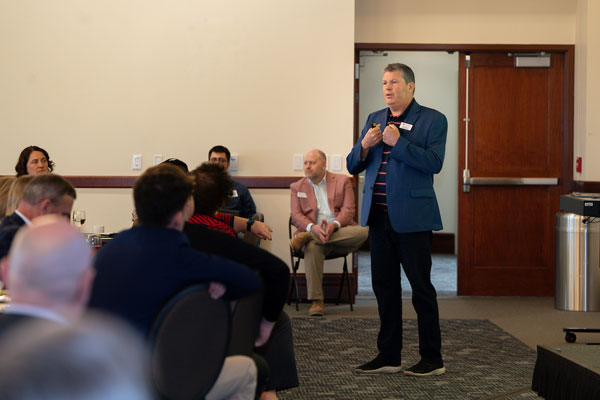
That collaborative sentiment essentially served as the spine of the talk given by Rogers, who founded the Federal Innovation Network and the Cyber Advisory Partners security and defense technology consulting firm, among others. His work in those fields stretches back to the mid-1980s, when he was a federal account manager for a company that, among other tasks, created war games and other systems for affiliates of the Department of Defense.
Rogers’ presentation, “From Human Doing to Human Being,” reckoned with the daunting prospects of artificial intelligence and the ever-looming question of whether AI can resolve more of humankind’s difficulties than it will ultimately create.
He made no bones about AI’s enormity, likening it to such cornerstone advancements as the wheel, the printing press and the compass: “AI is as profound as these, if not more.”
Its economic impact, he continued, is “massive” and he noted that countless people utilize AI, often on a daily basis – indeed, 94.7% of U.S. companies currently employ some form of it, he said – but he also revealed that recent studies have shown that nearly as many people who use AI also chronically distrust it, fears which he feels have a solid foundation.
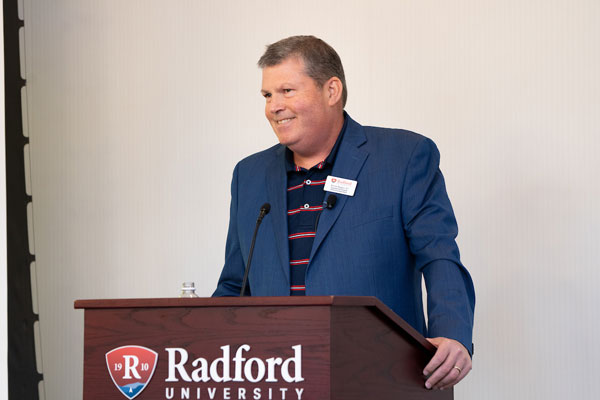
“We still do not have regulations and standards set today by our federal government, or even state institutions,” Rogers reported. “There is still no federal framework for risks and assessments and the standards we use for AI.”
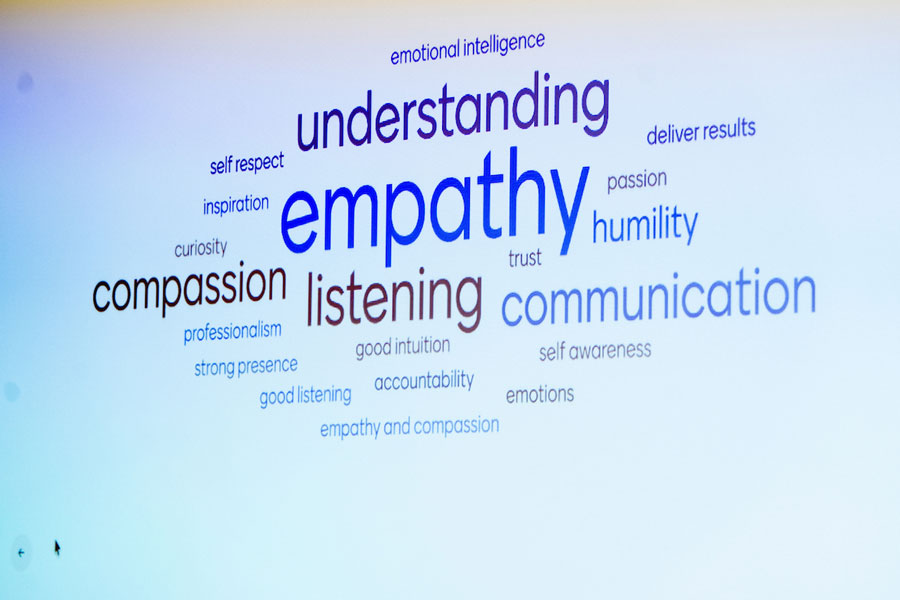
But the trick to mastering the technology, he maintained, is integrating human elements into the process, and he emphasized the importance of empathy and leadership in approaching AI.
“The human in the loop will always be involved,” he said. “The human has to lead it.”
As an example of that, he pointed to one of the world’s largest technology companies, Google, whose top skill sets for leadership, he said, focus largely on flesh and blood factors: empathetic interaction and coaching, strong human communications, career development acumen, productivity and prioritizing a team’s empowerment and well-being.
“I think listening is a critical skill” in cultivating AI, Roger concluded, urging students: “We have to lead it. We have to guide it. We have to instruct it, and then we can use it to create phenomenal outputs for us.”
Rogers also challenged instructors of higher education.
“If you’re not embedding AI in every single class you’re doing today, you’re not enabling the students to go into the workforce today, because everybody expects [them] to use that tool to become highly efficient … and that’s going to determine if they get their foot in the door.”
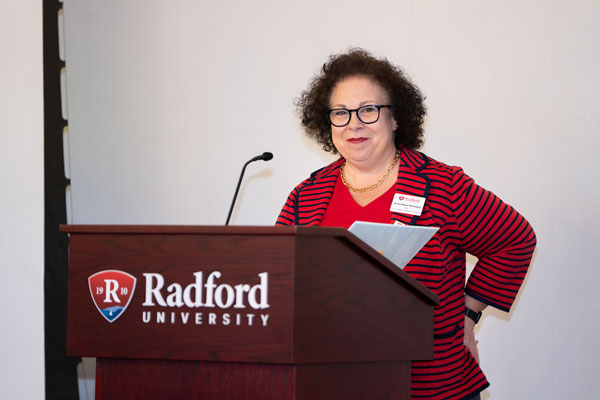
In her remarks, Davis College Dean Donna McCloskey supported Rogers’ stance on that.
“We are at a moment where technology is reshaping every industry, every role, and every definition of leadership. The question isn’t just what AI can do; it’s what humans must do better. Conversations like this help our students understand how to think, adapt, and lead in a world that is changing in real time,” she said.
“Kevin Rogers represents the very best of what it means to be a Highlander,” McCloskey added. “His career is remarkable, but what matters just as much is his commitment to staying connected and creating opportunities for our students. That’s what great alumni do. They don’t just succeed, they reach back, open doors and make sure today’s students have a faster, stronger path forward.”
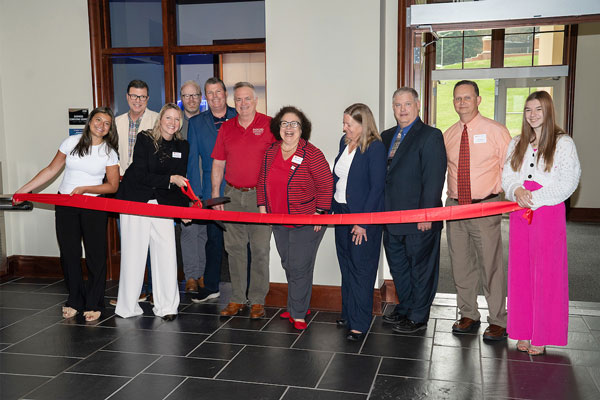
Along those same lines, the spring Truist lecture also saw Davis College’s AI Sandbox director, Samantha Steidle, announce the official launch of that facility, which she said would emphasize the opportunities of the advancing technology along with the ongoing need to maintain its accuracy and lack of bias, and to address the environmental impacts of the hardware.
The Sandbox, she explained, will also facilitate student AI certification while collaborating with such disciplines as cybersecurity and risk management, particularly as AI sees greater integration with healthcare, finance and public systems.
“We are advancing a movement that’s focused on preparing and upskilling the next generation,” Steidle said, and she thanked President Bret Danilowicz, Provost Bethany Usher and Dean McCloskey for their support.
McCloskey concurred.
“Through initiatives like the AI Sandbox and today's Truist Lecture,” the dean said, “we’re giving students the tools, experiences, and confidence to navigate this new frontier and graduate ready to compete, contribute and lead from day one.”