Radford students preparing for spring break trip to explore, research national parks in western U.S.
by Chad Osborne
February 25, 2026
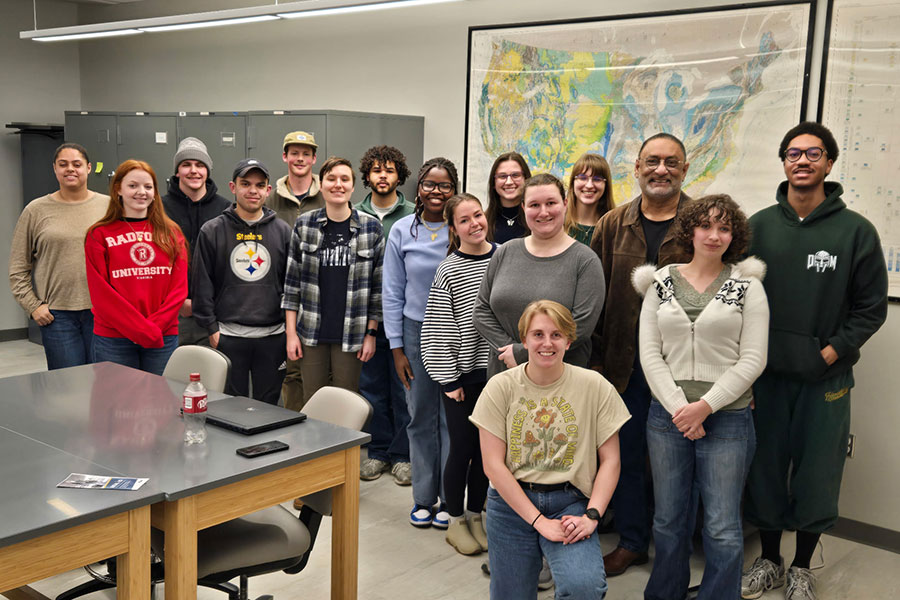
When Wyatt Hall first read about a course that fit perfectly with both his majors and offered a unique opportunity to explore and conduct research at a U.S. national park over spring break, he knew he could not let the moment pass him by.
“I have to get in on that,” recalled the sophomore geology and recreation, parks and tourism double major from Atkins, Virginia.
The course, Regional Geology of the United States, is enabling Radford University students to learn about geologic materials, processes and history by focusing on a specific region in the United States. The spring semester course centers on the geology of U.S. national parks, specifically those west of the Mississippi River.
“Our national parks offer relatively safe and easy access to these landscapes and an incredible opportunity to really drive home the things an undergraduate would learn in a typical geology class, but in a much more tangible way,” said Ryan Sincavage, an associate professor in the Department of Geospatial and Earth Science. Sincavage is co-teaching the course with Parv Sethi, a professor in the department. “Our hope is that this experience is an opportunity for them to grow, not only in their academic knowledge of science but also personal growth as it relates to their connection to the natural world.”
As part of the course, students and faculty will travel in early March, during the university’s weeklong spring break, to Arches, Canyonlands, Zion and Grand Canyon national parks. There, they’ll each complete a research project on one of the places they visited. Each of the students, representing a variety of majors, will present their findings at Radford’s annual Student Engagement Forum in late April. Students will also be required to complete a project on a national park they will not visit and later create a podcast or YouTube video about their experiences.
“The intentional mixing of different majors for this trip has been designed to provide our students with a truly interdisciplinary opportunity to not only conduct cross-disciplinary research while in the national parks but to also be able to learn from each other and the different perspectives each student brings,” Sethi said.
Hall jumped at the chance to enroll in the course in hopes of gaining research experience that fit his academic curiosity, he said.
“This will be my first time getting to collect data and try to add to the knowledge base,” Hall said, “and as an outdoorsy person, I am stoked to be able to get to visit some amazing national parks as a part of my education.”
Hall’s research focuses on hoodoo rock formations in Bryce Canyon National Park. It’s academic work, he said, that could provide a baseline for future research, “as well as possibly aid the national park in focusing on specific formations to protect and help them map future trails away from dangerous formations.”
Like Hall, Ava Gorski jumped at the chance to enroll in the course that required an interview with the faculty to be accepted. About 50 students applied for the course, and 15 were chosen.
“This course application was announced in September during a [geology] department seminar, and I don't think I've ever scanned a QR code as fast as I did once I realized what this course would entail,” Gorski said.
The senior geology and chemistry double major from Chesapeake, Virginia, is researching the Grand Canyon’s Great Unconformity.
“The Great Unconformity denotes 1.3 billion years that are missing in the rock record,” Gorski explained. “Seeing as Earth is 4.6 billion years old, that's a lot of missing time. I will be reviewing some hypotheses as to what may have caused this gap in time and the methods used to figure them out.”
Along with their research time, students will spend much of their time hiking and camping through the national parks. Given the time of year and the moderate to high elevations, preparing for the trip is a bit of a challenge.
Sincavage and Sethi, both of whom are experienced field researchers, are preparing their students to expect all types of weather – hot, cold, wet and dry – and encouraging them to pack sturdy, yet comfortable boots, rain gear, lots of clothing layers and warm hats and gloves. They will also carry a hydration bladder, a field notebook, a camera and a handheld GPS.
It’s a lifelong ambition for Gorski to visit every U.S. national park. The upcoming trip gets her closer to achieving that goal and also gives her hands-on research experience.
The trip is “a chance to immerse myself in my field of study while gaining key survival and field work skills,” said Clarie Daniel, a sophomore geology major from New Kent, Virginia. Daniel will spend the semester and her time out west focusing on the bleaching of Navajo sandstone.
“I'm investigating the history of ancient fluid flow through these formations,” she explained. As a history minor, I find that unearthing stories within rocks and outcrops and reconstructing what happened millions of years ago is what truly inspires me as a scientist.”
National parks, Gorski said, “are such an important establishment to the conservation of nature and our ecosystems. They are mostly sedimentary in nature, which means they are the best record-keepers of geological time and the events that have occurred in our planet's history. I can't wait to see them with my own eyes!”