Radford students become national parks explorers, researchers over spring break trek to western U.S.
by Chad Osborne
March 17, 2026
It’s difficult to put into words, Ava Gorski said, reflecting on the gorgeous natural-world beauty she experienced over spring break.
Still, she tried articulating what she witnessed over the weeklong academic journey out west.
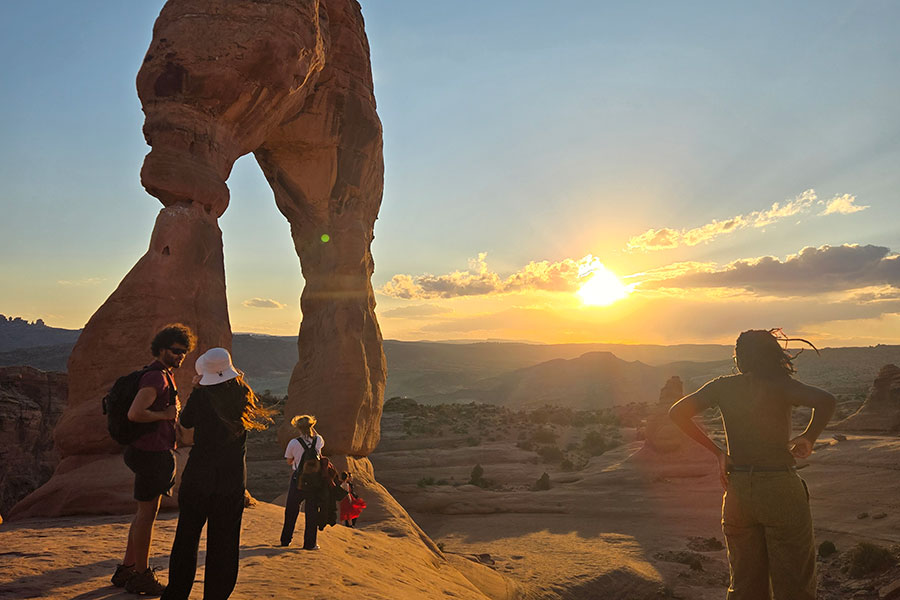
“The landscapes were breathtaking,” said the senior geology and chemistry double major from Chesapeake, Virginia. “Honestly, I was left speechless most of the time.”
In early March, students enrolled in Radford University’s Regional Geology of the United States course spent days exploring and researching features found within Arches, Canyonlands, Zion and Grand Canyon national parks. Each student will present their research findings at Radford’s annual Student Engagement Forum in late April. Students are also required to complete a project on a national park they did not visit and later create a podcast or YouTube video about their park experiences.
“Going to all of these national parks showed me just how variable the geology of our country is and how quickly the lithologies and landscapes change,” Gorski said. “One minute, you're driving across flat plains covered in modern sediment deposits, and then all of a sudden, you're driving through towering cliffs of sandstone.”
The geology faculty duo who teach the spring semester course and led the journey – Ryan Sincavage and Parv Sethi – provided informal lectures along the way.
“I felt like I was entering a new world every time we went through the welcome posts at the parks,” said Jennah Dimaggio, a senior geology major from Chico, California.
In the parks, each student worked on an individual research project, focusing on one of the parks they visited. Gorski had intended to delve into the Grand Canyon’s Great Unconformity, but a week before the trip switched to examining a series of six Jurassic unconformities that could be viewed across the Colorado Plateau. “Sometimes that's how research rolls,” she said, explaining the last-minute change of plans.
Toby Windish agreed. He, too, switched research focus as the trip neared.
“My initial question was how biocrust microrelief varied with distance from the trail,” explained the biology major, who enrolled in the course to gain more hands-on research experience. “I had to pivot slightly to compare biocrust microrelief alongside more and less popular trails and between Arches and Canyonlands, as it did not appear possible to venture off-trail without disturbing the crust.”
Inclement weather forced Wyatt Hall to change his research plans for Bryce Canyon in Utah. “It had snowed the morning we got there, and as a result, the trails I needed to get on were closed,” said the sophomore geology and recreation, parks and tourism double major from Atkins, Virginia. “I was thankfully able to work around it for the most part, and I was able to collect enough data.”
The only caveat to the trip “was simply not having enough time to truly explore the parks to find all of the unconformities I was looking for, so there are only three I was able to take notes on,” Gorski explained, “But I think it's safe to say we all wish we had so much more time in all the parks because they were so cool.”
All work and no play can make for a dull spring break trip, so when there was time, the students and faculty leaders explored the beauty and wonders of each park. One such endeavor involved renting gear and hiking more than a mile along the Virgin River, which carves a path through the red sandstones of Utah’s Zion National Park.
“I was a little nervous to do this hike,” Gorski confessed, “but it ended up being one of the coolest experiences of my life and one that I will never forget.”
Windish agreed. “My fellow students and professors are wonderful travel companions,” he said, “and I will remember this trip fondly for the rest of my life.”
Sincavage said he was pleased to hear students after the trip say that one of their favorite parts of the experience was getting to know each other on a deeper personal level.
“All of these attributes – being mindful and attentive, and making strong social connections with peers – are crucial for successful scholarly work,” said the associate professor in the Department of Geospatial and Earth Science. “An experience like this is tailor-made to equip our students with those very important skills.”
While many university students rightfully view spring break as a brief respite from academic rigor, Gorsky chose to be part of the experience because, “I personally love to learn and experience geology in the field,” she said. “Sure, a true break from academics may have been nice, but experiencing all of those national parks and getting to learn about them was much more valuable to me.”
The path and itinerary that Sethi and Sincavge planned worked perfectly for allowing the students to explore “bigger and bigger geological landscapes with each passing day,” said Sethi, a professor in the Department of Geospatial and Earth Science. “Each day their jaws dropped lower, and eyes grew bigger, culminating with the Grand Canyon, where they were practically giddy with amazement and the joy of discovery.
“These students,” he continued, “will now forever see our planet and parks differently and in a better and more compassionate light.”