Biology major measuring, comparing Hurricane Helene’s environmental impact
by Chad Osborne
July 07, 2026
Katie Purnell grew up on the rivers of western North Carolina, camping, swimming, hiking, committing to memory every rock and every tree that lined their banks.
“But now it’s all different,” she said of the area’s streams and surrounding areas. “And it’s devastating to see.”
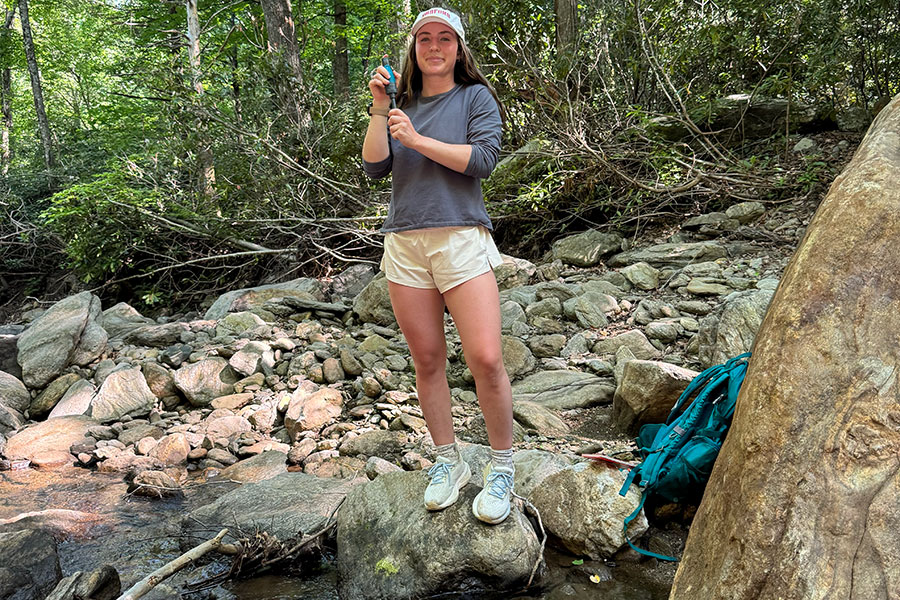
In late September 2024, Hurricane Helene ripped through the southeastern United States, causing widespread catastrophic damage along its path. The Category 4 storm produced tornado-force winds and driving rain that sparked devastating flooding throughout mountains, valleys and small towns. Some of the greatest damage occurred in parts of Virginia, Tennessee and North Carolina, including in and around her hometown of Asheville.
Weeks after the storm, Purnell, then a sophomore, was busy assisting Professor of Biology Jason Davis on his research – Helene’s disruption of crayfish in the tri-state region – when the two began discussing how Purnell could create her own project. She had already helped gather water samples in Virginia and Tennessee, but her busy academic and athletic schedule – she’s a prominent member of the Highlanders women’s soccer team – had limited her travels back home to western North Carolina to see for herself the devastating punch Helene had delivered to the area’s river and landscape.
But during the summer of 2025, over summer break, Purnell did go back, walking the South Toe, French Broad and Swannanoa rivers to gather samples and collect water samples containing hormones that diffused from crayfish into deionized water for Davis’s research.
That’s when she saw for herself how the storm had dramatically altered the landscape.
“These were not the same rivers,” she recalled.
A couple of months later and back in the labs at Radford with Davis for the fall semester, hours of brainstorming between the two produced an idea for a project that would lead Purnell to examine, analyze and compare water quality of the damaged areas in Southwest Virginia, northeast Tennessee and western North Carolina.
In developing the project, Purnell hypothesized that the North Carolina and Tennessee watersheds, squarely in Helene’s destructive path, “experienced greater storm trauma and therefore will exhibit longer lasting impacts, such as significantly lower crayfish species diversity, higher concentrations of heavy metals and altered water chemistry,” compared with rivers in southern Virginia, which more closely mirror pre-storm norms, she wrote early this year in an application for one of Radford’s 2026 Summer Undergraduate Research Fellowships (SURF) grant.
In January this year, Purnell began sample collection in Virginia while finalizing the sampling plan and field schedule for summer data collection in North Carolina and Tennessee, a process that continued throughout the spring and early summer.
At each river site, she used Vernier probe equipment, which connected to her phone through Bluetooth, to test pH, dissolved oxygen, salinity and turbidity.
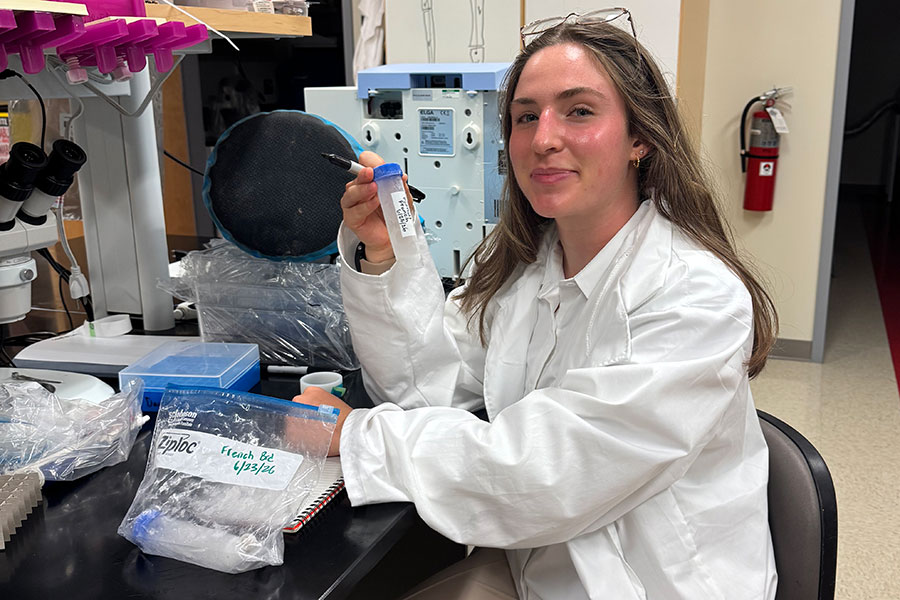
This summer, Purnell is back on campus testing samples she collected for heavy metals such as lead, arsenic and mercury, as well as nitrates and phosphorus. She is running those tests using the Radford biology department’s Nanopore MinION sequencer to map crayfish eDNA signatures from each target watershed, “relating this to the chemical and hydrological features of these streams and rivers,” Purnell noted.
“By assaying eDNA signatures and relating them to water quality metrics,” the rising senior biology major continued, “I hope to gain insight into the state of these waters and how their crayfish biodiversity may have been significantly impacted by Helene.”
Purnell’s research is giving her plenty of opportunities to collaborate with Radford faculty and fellow students. In addition to assisting Davis, she is working with Professor of Chemistry Christopher Monceaux to test water samples for pollutants using mass spectrometry, and Assistant Professor of Biology Steven McBride is lending his expertise. Purnell is also working with geospatial science major Kiara Bartoli to create a 3D interactive map from photos Purnell took of each watershed.
“I’m really excited for that because I think when you see the visuals of these locations with the landslides and the overall trauma,” she said, “it really puts it all in perspective and helps tell the story.”
Purnell plans to present her findings from her research in January 2027 at the Society for Integrative and Comparative Biology annual meeting in Pittsburgh, Pennsylvania.
In addition to the helpful collaborations, Purnell’s research has been assisted by the SURF grant awarded to her in the spring. She was among the 20 recipients of the grant given each year by the university’s Office of Undergraduate Research and Scholarship (OURS). The award comes with a $6,000 stipend for each recipient. Faculty mentors receive a $1,500 stipend.
“The SURF has been really helpful; I really needed it,” Purnell said, while describing the application process that produced an 18-page proposal for her work and why it was an important endeavor. That process, too, was a collaborative effort. “I had a lot of people read over it – a lot of people – including my teammate’s mom; she’s a lawyer.”
The overall hands-on learning experience is giving Purnell knowledge and skills she needs as she prepares for a career as a medical doctor, and the project alone is important to Purnell and many of her friends and family who suffered the storm’s carnage.
“It was really devastating to come back home after Helene to see the roads and small businesses completely gone. Plus, I have a really close friend who lost their house,” Purnell recalled. “It was just devastating. Everything changed. I really hope this project shines a light on some of the devastation that occurred around my hometowns, as well as the entire region.”