Here’s a quick sampling of the product pitches recently made by some of Radford’s student innovators.
First up: An app that helps freelancers and gig workers budget monthly earnings that skew less consistent and on a more modest scale. It’s aimed at 70 million Americans who don’t receive stable paychecks, according to the team behind it, and their tagline urges: “Start budgeting for unpredictable income.”
Or another concept, a DoorDash-style food delivery service that caters exclusively to one campus and its students. Its pitch observes that other schools in the state, like Virginia Tech and Old Dominion University, already have such servers up and running. For its motto, the proposed dashers declared: “We wait in line so you don’t.”
On a more festive note, there’s also a bakery that offers blind dessert boxes, combining the promise of tasty treats with the lure of the unexpected. “You pick the vibe. We surprise you.”
Those were just three of the ideas presented by business majors at Radford’s recent Innovation Challenge – INNO26 – on April 24 in Kyle Hall.
Hosted by the Davis College of Business and Economics and the Radford Venture Lab, INNO26 challenged 10 teams selected from the ranks of Entrepreneurship (ENTR) 350 and 450, courses that focus on new venture creation and owning and managing a business, respectively.
Five teams developed investment and innovation ventures, while the other five came up with prospective lifestyle or “Main Street” business ideas. Over a period of six weeks, they formulated concepts to sell, conducted research and development, then presented product pitches of roughly five minutes to a group of judges, all of whom are established business professionals.
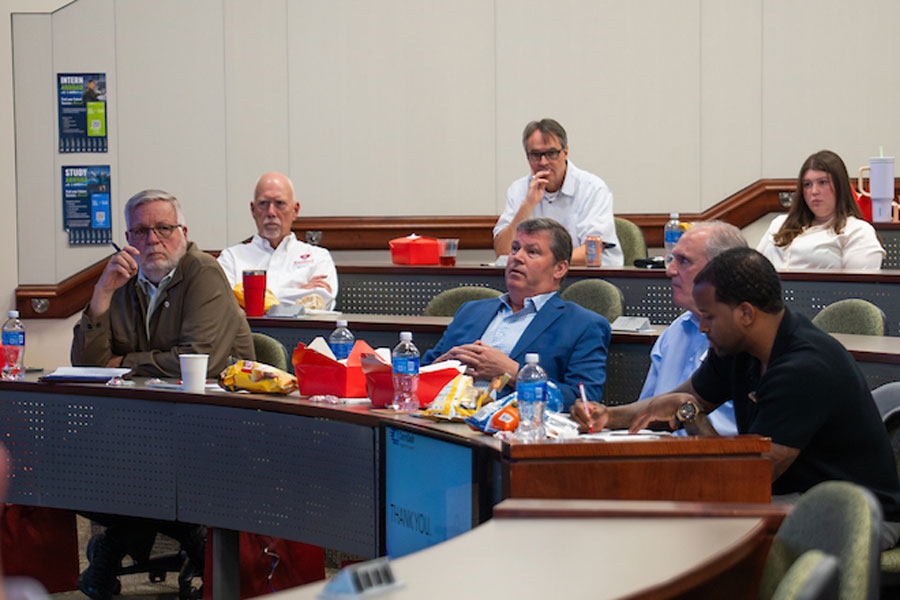
This year’s judging panel included Marty Rosendale, founder and CEO of Selnova, LLC; Kevin Rogers ’87, founder of Federal Innovation Network and Cyber Advisory Partners; Dan McKinney, business development officer for First Community Bank; and Chance Smith ’12, founder of the event services platform GoghNow.
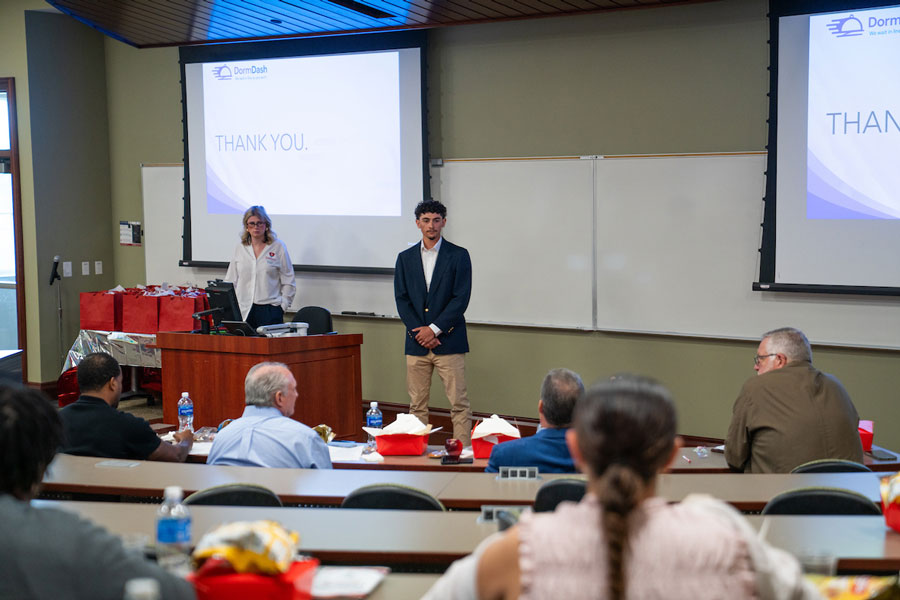
Presentations were held across several hours and had a casual, conversational feel – box lunches were available for participants to serve themselves whenever they felt like it.
But the challenges were multifaceted and real. Product proposals ran the gamut from artificial intelligence to waste management, with projected revenues that stretched from thousands into the millions, in some cases, while the students’ tasks incorporated public speaking, defending their positions with data and accepting feedback on the fly.
One early pitchman concluded his proposal and idly wondered whether the judges needed any additional information.
“We always have questions,” Marty told him, and in every case, they also had suggestions.
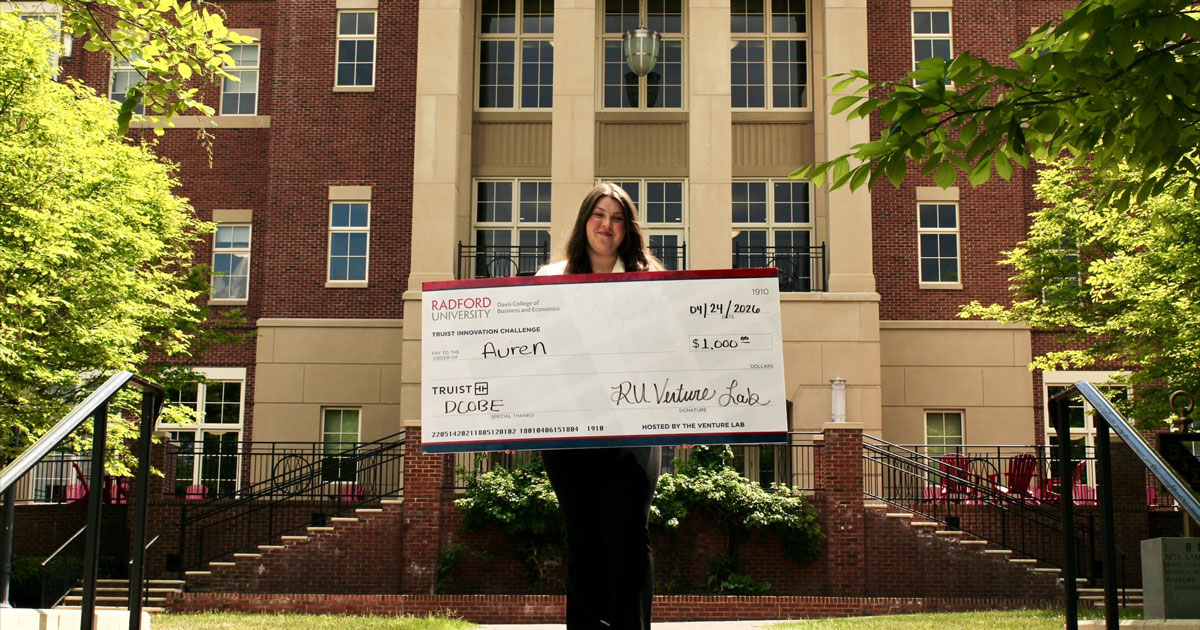
The top award went to junior management major Emily Lewis. Lewis, working on her own, earned the competition’s $1,000 prize for her project, Auren, which proposed curated wellness escape sessions at small-scale luxury retreats in natural locations.
Teams that were named finalists in the investment and innovation venture category were:
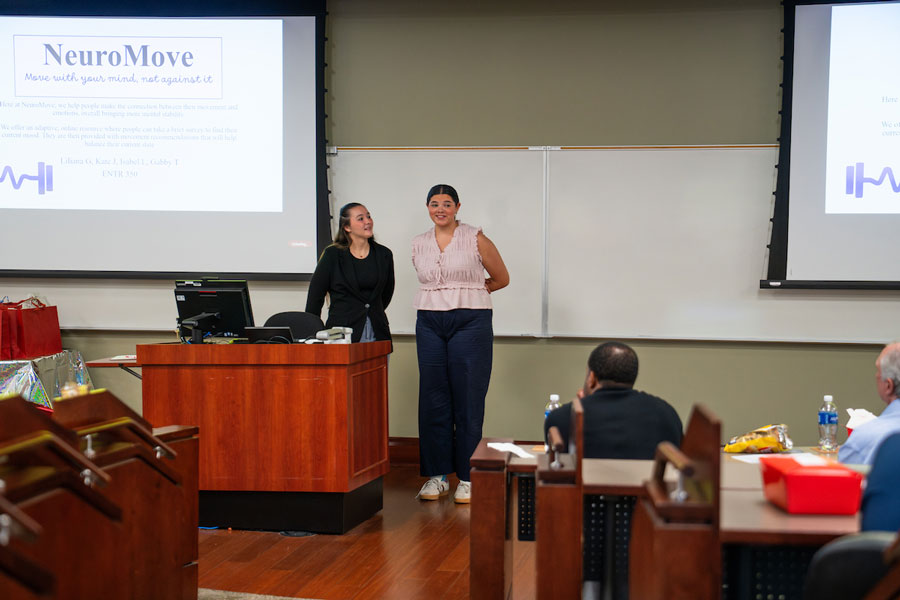
NeuroMove, a movement-based mental wellness app, with team members Liliana Grandela, Kate Jarvin, Isabel Lutz and Gabrielle Tenia.
ReconAI, a program and app for cash reconciliation for individuals and small businesses and its team of Hunter Denton, Kimberly Forloines, Rachel Harless, Samuel Hubbard, Alexander Smith and Hope Wyatt.
In the lifestyle category, in addition to Auren, finalists included:
Frame Studio, which sought to offer production and beauty services specifically for social media content creators. That team’s members were Jaylin Aviles, Leiara Malone and Morgan Oakley.
Chair of the Department of Management Jerry Kopf leads ENTR 450, and Assistant Professor Jack Mason is the ENTR 350 instructor. Both acted as INNO26’s chief coordinators.
Mason said he and Kopf were impressed with this year’s entries, adding that in many cases, students created their own websites for their hypothetical products. Beyond technical know-how, he said, the challenges also reinforced another important quality young businesspeople need.
“By doing these kinds of pitches – and I've done dozens and dozens of them when I raised venture capital – you learn, and you adapt. And as I told my students, the idea is to learn to take input,” Mason explained.
“Because probably the most significant valuation criteria for investors, and the most important attribute of management teams and entrepreneurs is, 'Are they coachable? Are they willing to take input? Will they listen, or do they think they know it all?'” he said.
Macie Rice ’22, MBA ’23, program coordinator for the Venture Lab, said INNO26 is more than just an event.
“It’s a transformative experience for our students,” Rice said. “It gives them the opportunity to take an idea they’ve been building and step into the spotlight with confidence, professionalism and purpose. It empowers students to see themselves as innovators and leaders, and that impact goes far beyond the stage.”