Highlander Highlights: Week of March 23, 2026
March 27, 2026
Highlander Highlights shares with readers some of the extraordinary research and accomplishments happening on and off campus through the tireless work and curiosity of our students, staff, alumni and faculty.
Honors College students visit the Eternal City
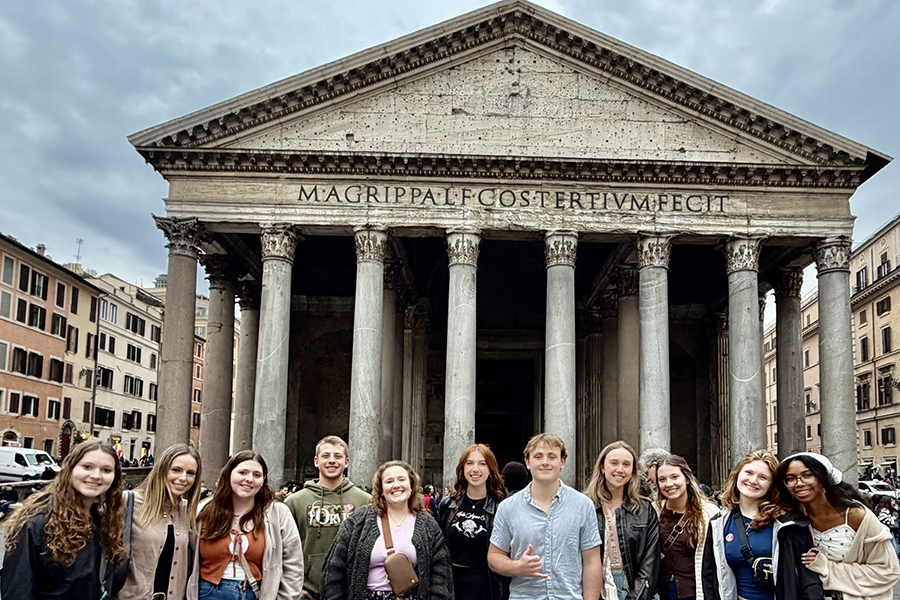
Eleven students from the Radford University Honors College spent spring break exploring history, philosophy and culture in Rome, Italy, during the college’s first-ever study abroad experience.
The trip was part of the honors course Psychology of Transcendence, taught by psychology professor and Honors College director Niels Christensen. The course examines meaningful experiences and lifelong structures that contribute to living a “good life,” a question that has been explored since the ancient philosophers and early Christians.
“To understand these ideas, Rome is an incredible classroom,” Christensen said.
During the weeklong excursion, students encountered the city’s rich layers of history and spirituality. A visit to St. Peter's Basilica “literally took the breath away from many of us - a true experience of awe at the scale and intricacy,” Christensen said. Throughout the city, they also viewed numerous sculptures by Baroque master Gian Lorenzo Bernini.
Students explored Rome’s remarkable historical depth at the Basilica of St. Clemente al Laterano, a 12th-century church built atop a fourth-century church, which itself sits above a first-century Roman temple of Mithras. The layered structure offered a powerful visual reminder of the city’s thousands of years of history.
The group also traveled outside the city to the mountain town of Subiaco, where the quiet monastery associated with St. Benedict provided a peaceful retreat from Rome’s busy streets.
Beyond the historic sites, students experienced Italian culture through long dinners, conversation and the hospitality of locals. “The extended dinners of pasta and conversation will be lifelong memories,” Christensen said.
The trip marks the beginning of what the Honors College hopes will become an annual spring break tradition. Plans are already underway for future honors study abroad experiences, including trips to Venice, Italy, in 2027 and London, England, in 2028.
Biology professor researches a surprising bird habitat
Cemeteries can be surprisingly lively places – at least when it comes to bird behavior. In a recent publication in Birds, an open-access ornithology journal from MDPI, Associate Professor of Biology Sarah Foltz explores how cemetery landscapes influence how birds behave and interact with their environment.
Burial grounds are often overlooked as urban green spaces, but like parks, they typically include open grassy areas, trees, varied vegetation and differently shaped monuments – features that affect bird foraging, movement and interactions. For example, in Salem, Virginia, a northern mockingbird was observed drop-foraging from the surface of an obelisk, illustrating how birds use man-made structures as part of their search for food.
Foltz conducted her research during the summers of 2024 and 2025 at four cemeteries in Roanoke and Salem. Her work expands on previous studies of species richness, community composition and habitat use to the actual behavioral responses of birds – a key component of understanding how wildlife adapts to human-modified environments. Recognizing how landscape features influence behavior helps urban planners and conservationists design and manage these spaces in ways that enhance habitat quality.
This summer, Foltz will be on sabbatical in Portugal, “surveying Anglican and Catholic cemeteries there as comparison points to each other and to our non-denominational cemeteries here,” to see how culture and religion shape cemetery design and how those differences influence birds’ use of them.
“I’m working in city parks as well,” she said, “to get an explicit comparison point to other urban green spaces in the same cities. I'll be looking at both basic population and community structure (bird abundance, species richness) and also observing foraging behaviors.”
Undergraduate researchers show up in force at STR
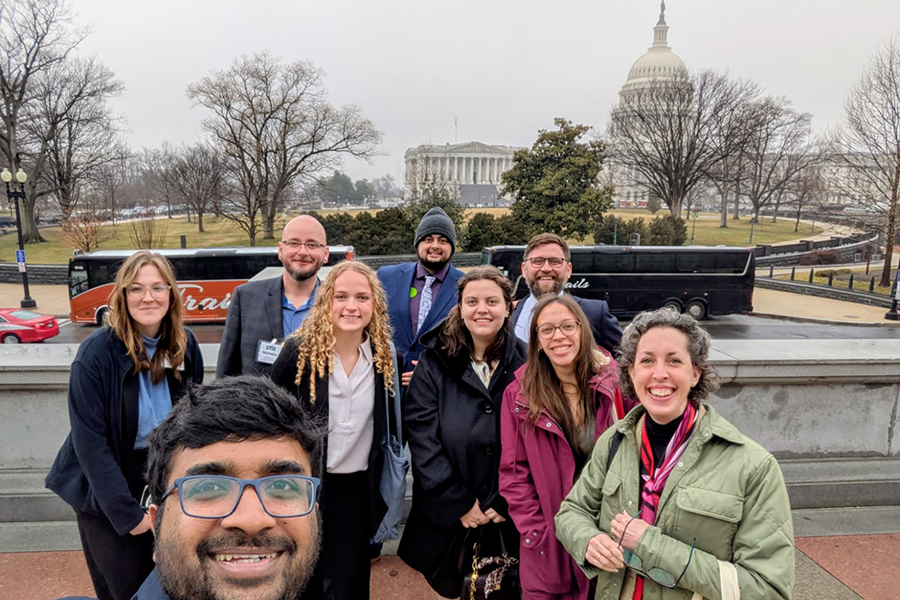
Undergraduate researchers from Radford University traveled to Washington, D.C., early this month for the Council on Undergraduate Research Scholars Transforming Through Research (STR) program, an initiative designed to help students communicate the impact of their research to policymakers and the public.
Radford sent the largest student delegation among participating institutions, underscoring the university’s strong commitment to undergraduate research and experiential learning. The group included six students and three faculty mentors representing art history, geospatial science and psychology.
The students’ first day focused on training and networking events and connecting with fellow participants, including a cohort from the University of Mary Washington. They followed that up on day 2 with meetings on Capitol Hill, including visits to the Library of Congress and the historic Jefferson Building. Later, they met with staff from the offices of Rep. Morgan Griffith and Sen. Tim Kaine. During these meetings, students shared their original research and discussed the importance of undergraduate research opportunities.
“The faculty mentors and I decided that this was the students’ time to shine,” said Carlee Bradbury, professor of art. “They shared details about their individual and original projects as well as the importance of undergraduate research for them. The meetings were conversational, and all the students represented Radford with grace, eloquence and professionalism.”
“This experience highlights the value of hands-on learning in connecting academics to real-world impact,” added faculty mentor Naveen Joseph, assistant professor of geospatial science.
College of Nursing inducts students into honor society
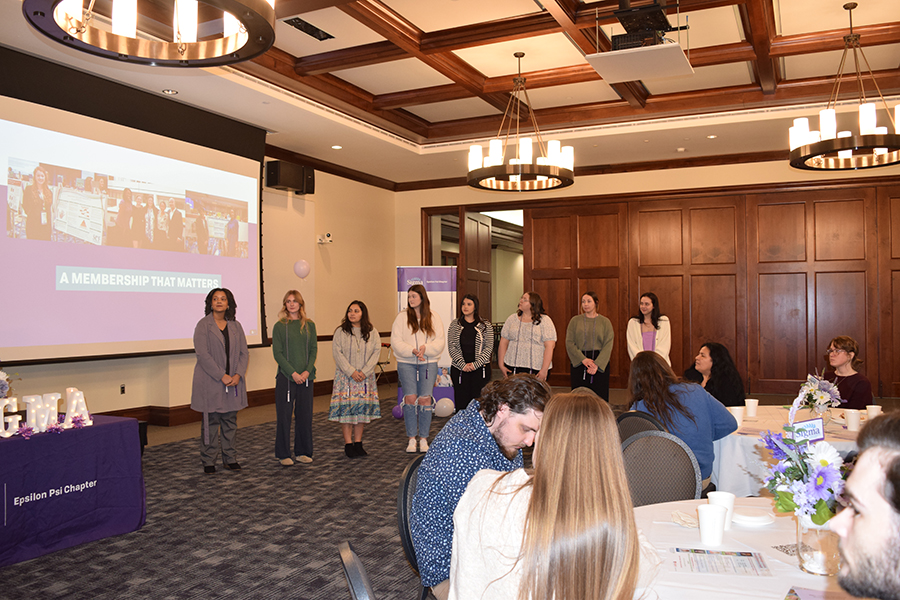
The room was decorated in shades of purple. A bright table cover with the illuminated word SIGMA was surrounded by flowers, candles, balloons and a matching banner. The 15 purple-and-white twisted honor cords each represented a student being inducted into the Epsilon Psi chapter of Sigma Theta Tau International Honor Society of Nursing (Sigma) at Radford University on Friday, March 13. Eleven students were from the undergraduate program, and four were graduate students.
Ottilia Lewis, a nursing administration graduate student from Roanoke, Virginia, reflected by saying, “As a trauma nurse and MSN student, being inducted into Sigma Theta Tau is an incredible honor that reflects both the journey behind me and the purpose ahead.”
Two College of Nursing faculty members also participated, with Kimberly Stevenson’s induction as a nurse leader and Assistant Professor Amy Woods serving as the keynote speaker. In addition to honoring core traditions, the ceremony incorporated student-led scholarly presentations on the development of current evidence‑based projects aimed at improving patient care within the profession.
Lewis’ presentation, titled "The Impact of School-Based Injury Prevention Curriculum on Older Adolescent [Motor Vehicle Crash] Mortality," provided an overview of the education and research at the Level I trauma program at Carilion Roanoke Memorial Hospital, which aims to bridge the gap between bedside nursing and realistic change.
Brandy Thacker, a senior in the prelicensure nursing program, presented her scholarly work on the transition from hospital to home for medically complex infants and how caregivers can use educational strategies to build confidence in their caregiving.
Faculty member recognized for advancing stroke rehabilitation
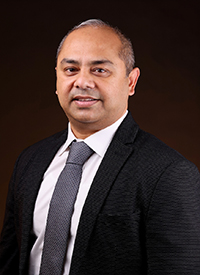
Arco Paul, an associate professor in the Radford University Doctor of Physical Therapy program, since 2017, was recently recognized by the Academy of Neurologic Physical Therapy (ANPT) for his outstanding and sustained professional service within the Stroke Special Interest Group (SIG).
“It is a great honor to be recognized by the Academy of Neurologic Physical Therapy,” Paul said. “Our initiatives are focused on disseminating educational resources through accessible social media platforms tailored to the learning preferences of today’s healthcare students and professionals, with the goal of effectively translating best evidence into the clinical practice of stroke rehabilitation.”
For five years, Paul has worked with the Stroke SIG to advance empirical stroke rehabilitation. He created accessible research summary reviews, developed educational video case studies on high-intensity gait training and worked with ANPT’s student corner to establish social media education for physical therapy students and early career professionals.
Paul’s interest in stroke rehabilitation stems from his experience as a practicing physical therapist and research-trained neuroscientist. “I have always been interested in looking for innovative and more effective ways to help people with neurologic conditions, since they often face the most difficult recovery trajectories,” Paul said. The continual emergence of new tools, technologies and creative solutions maintains and drives Paul’s interest in the field.
In addition to his educational contributions, Paul served as the awards committee director for the Stroke SIG from 2023 to 2025, where he improved and streamlined the selection process for stroke-related posters and platform presentations at ANPT peer-reviewed conferences, as well as for outstanding research nominations.
Compiled by Joya Garris and Pam McCallister