Ding! Ding! Ding!
“What’s that noise?” a gaucho asked as he and others set up camp near the fossil bed the team had explored earlier in the day.
Is it a wild animal? What is it?
The gaucho had lived in the area, Northern Patagonia, since he was a kid, and yet, “I’ve never heard that before,” he confessed.
As the group listened more intently, the dings became apparent. “Oh, that’s just Bode hitting rocks with his hammer,” the tour guide said with a smile.
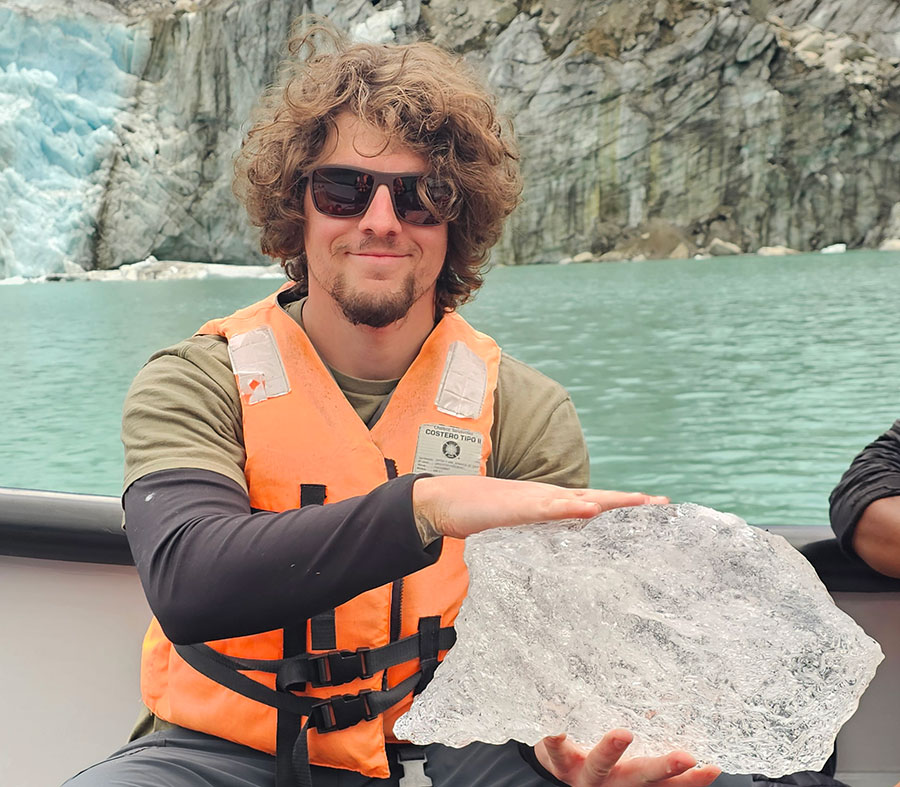
Bode Lindauer ’26 was always exploring, “cracking open rocks and looking for minerals,” Radford University Professor of Geology Ryan Sincavage said later about Lindauer.
Early in the 2026 spring semester, Sincavage asked Lindauer to accompany him on a fact-finding mission to the Patagonia region of South America to explore future research options for other Highlanders in the area.
Once upon a time not so long ago, Sincavage offered Radford students a study abroad course with a two-week trip to Patagonia, a region shared by Chile and Argentina. There, students explored the region, including a couple of national parks, while learning about the geology and culture of the area.
“It was a great experience,” the professor said. “No cellphones, just hiking, camping, cooking over a fire. It was great.”
After COVID, however, the prices for such excursions soared, making the trip less affordable. So Sincavage put the course on hold. Plus, the physical demands of the trip forced him to reconsider how he would operate the course in the future.
Sincavage occasionally travels to Patagonia for his own research, and on a recent trip, he discovered a potentially better option for his students. But first, he wanted to get the student perspective on possible class activities for future courses.
“Students are always telling me they heard about the Patagonia trip, and it was one of the reasons they came to Radford,” Sincavage said. “So I did a recon trip there recently,”
The thought process behind the trip, Sincavage explained, was to run through it with a guide and figure out how the students could get the most from the experience. In addition to Lindauer, Sincavage’s partner, an experienced mountain guide, went along to provide expertise.
Early on, the group found “some of the most amazing fossils I’ve ever seen,” Sincavage said, optimistically thinking ahead to what future Highlander tripgoers could experience. “There were mammals and other animals walking around Patagonia 30 million years ago, and we got to see evidence of it.”
That was just the beginning.
Later, the group camped for two nights at the base of a glacier that produced thunderous cracking sounds throughout the night. “You could hear the loud cracks it made,” Lindauer said, “and you could actually see ice falling from it.” Later, the group strapped on crampons and walked across another glacier, absorbing all its breath-taking features. The water around it “was like blue Gatorade,” Sincavage recalled. “And you can drink it; the water is so clean.”
Over the course of a few days, Sincavage, Lindauer and the crew made three small excursions, and each had elements of the professor’s previous trip. It was less physically challenging, and it offered more opportunities to interact with local culture, something Lindauer cherished.
“The people there were so nice, and the food was even better,” said the Fredericksburg, Virginia, native. “I felt accepted there by people who really don’t know me, but who continuously want to learn with me.”
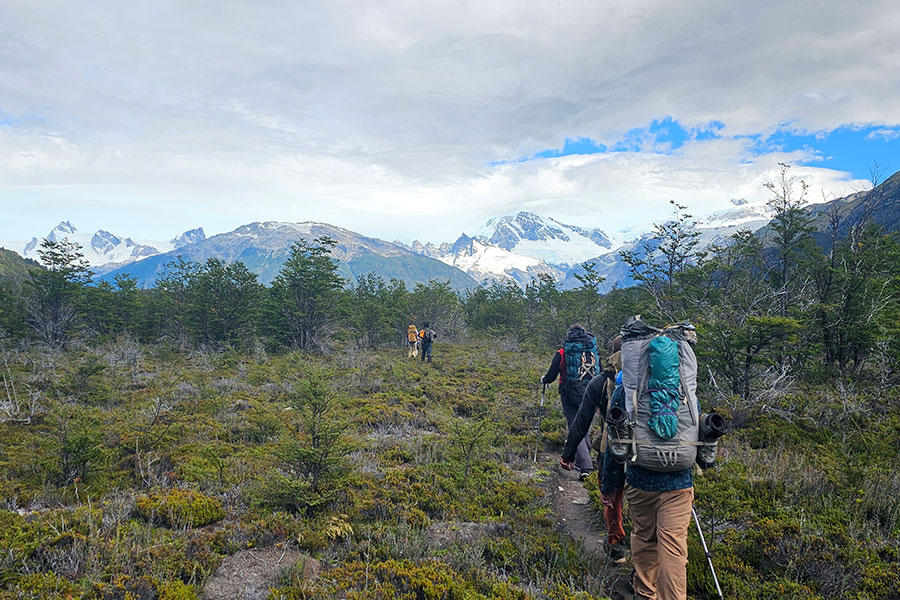
Sincavage sees the future of the class, which he plans to offer soon, to be more research-focused than previous journeys, perhaps resembling the university’s popular Radford Amazonian Research Expedition (RARE) research treks to Peru. A colleague of his, whose work focuses on conservation in Patagonia, has plenty of research ideas for Radford students, projects that involve geologic mapping, surveying, wildlife tracking and so on.
Sincavage hopes students, no matter their major, can take with them to Patagonia the same scale of passion Lindauer exhibited. Or at least pretty close.
Early in the trip, before the group set out on an excursion, the group’s tour guide asked Sincavage why he selected Lindauer for this important fact-finding mission.
“You’ll find out,” Sincavage replied. It didn’t take long for Lindauer’s passion and expertise to reveal themselves.
“All the locals were asking him questions, not me,” the professor said. “They would ask, ‘What kind of rock is this, Bode? Where should I look for other rocks, Bode?’ They were really excited to talk with him, and it was a really cool thing to see him, a student, sometimes take over as the geology expert.
“And that was fine with me,” Sincavage said proudly with a smile.
While walking at the base of Tronador, the thunderous glacier in Northern Patagonia that rises to 11,200 feet, Lindauer made a surprising discovery that soon amazed everyone around him.
“I looked down to find something we rarely see, ultramafic rock,” said Lindauer, a Radford research scholar who graduated in May. “I dropped everything I had, picked it up and was like ‘Oh my gosh, look at this!”
Lindauer explained the rock’s rarity to the field guide, who translated the explanation into Chilean Spanish to the other field guides along for the trip. “The smiles on their faces are something I can't even make up,” Lindauer recalled. “They were just smiling ear to ear and really happy to understand what they've been walking on for years.”
The moment was the perfect example of why Sincavage selected Lindauer for the mission.
“He has such a passion for rocks and minerals and geology,” Sincavage said. “And his energy about those things he loves is infectious. Bode was the absolute right person to take this journey with me.”