Great “Escape”: Radford trio wins national honor for research paper on gamified education
by Neil Harvey
December 03, 2025
Can game-time activities like escape rooms help prepare college students for the job market? Will they enhance education techniques in the classroom?
Those are some of the questions tackled by a recent research paper – co-authored by two Radford faculty members along with a second-year business student – which was just singled out for a national honor.
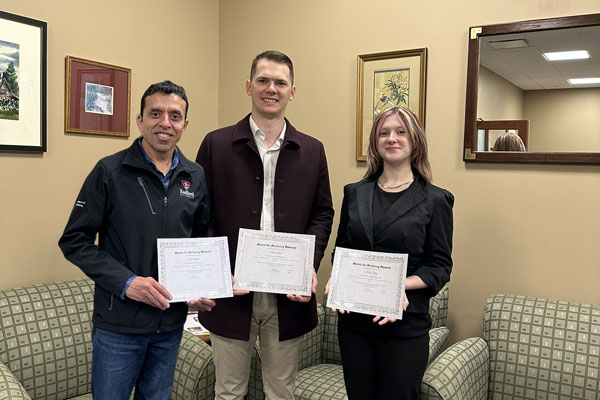
The study, “Escape Rooms in the Classroom: An Interactive Learning Experience,” was named “Best Paper in Track” at the Society for Marketing Advances 2025 Annual Conference in Las Vegas, Nevada, during the first week of November.
The project is the work of Associate Professor of Marketing Maneesh Thakkar and Assistant Professor of Marketing Luke Liska, and sophomore Haley Gilley, a marketing and management double major. The trio also collaborated with Zhihao Yu of the University of Nebraska at Omaha and Chu-Yen Pai from Minnesota State University, Mankato, both of whom are assistant professors of marketing.
Just briefly: Escape rooms are challenges that typically involve locking gamers into an enclosed space and asking them to solve a series of puzzles whose themed solutions allow players to regain their freedom. While Liska, Thakkar and Gilley don’t actually confine students in their classrooms, participants do still face the same kinds of linked problems associated with full-fledged escape rooms.
Using feedback from more than 160 students, the paper examines escape rooms as educational tools for business students, with a focus on the games’ ability to develop teamwork, critical thinking and adaptability – competencies deemed valuable by the National Association of Colleges and Employers (NACE).
“If you’re in a classroom giving lectures, you don’t really get to practice teamwork in communication except for the occasional group project,” Liska explained. “But when you have escape rooms, you pair people in a team of three, and they’re having to work together for the entire hour. In fact, if they don’t work as a team, they typically won’t get through the puzzle because it’s designed to require multiple students to actually be finished in that time.
“Escape rooms can help students learn skills that aren't easy to learn in the classroom, and our paper details, step-by-step, how any professor can implement escape rooms into the classroom.”
Gilley, of Critz, Virginia, was teamed up with Liska through Radford’s Research Rookies program, and they expanded their work into the project itself. She was tasked with analyzing escape room results he’d collected, conducting challenges with additional students and, ultimately, contributing to the paper itself.
“One of the things that we've thought about was using the gamification of education to help make it fun or to improve motivation,” Gilley said. “Our paper specifically focused on how professors can create escape rooms based on their coursework. So that way, it’s not just for business students. We came at it from a business student perspective, but really, anyone, any professor in any department can use it.”
According to the paper, when course lessons were funneled into escape-room-style puzzles, marked effects emerged.
“The students who studied more, or the students who knew the course material, they escaped,” Gilley said. “But what we also found is that even when the students didn’t escape, they still wanted to do escape rooms because it identifies details and lets them know more about what they need to study.”
In congratulating Gilley, Joe Wirgau, the founding director of the Office of Underground Research and Scholarship (OURS), noted: “It’s not every day you see a sophomore student winning national recognition while collaborating with four different faculty across three institutions.”
Gilley, who’s also double-minoring in economics and political science, credited Research Rookies for starting her on that track, one that includes her work as an Elevate mentor researcher and liaison with the Honors College. She also heads the campus chapter of the American Marketing Association, among other activities.
“The Research Rookies program specifically put me into a place where I would be able to do that work. If it weren’t for that program, I probably would have never gotten involved with research,” she said. “It’s really changed everything for me and my college experience. I want to become a marketing professor because of it. It really has played a big part in my life so far.”
That type of motivation connects with Liska’s original impulse to directly involve students in research work and collaboration. He recalled that as an undergraduate, he himself nearly drifted away from research work to take an accounting position.
“But I went to a conference with some professors at Tennessee Tech University, and our paper won a distinguished research award,” Liska recalled. “Winning that award at that time is what inspired me to get my Master of Science in marketing.
“My entire career evolved around winning that research award as an undergrad myself, so to be able to be part of a project today that sees an undergrad I’m working with get recognition, it’s kind of a full-circle moment for me.”